Showing posts with label bible. Show all posts

Thursday, March 14, 2019

The Neo-Babylonian Dynasty from Nabopolassar to Belshazzar

The Neo-Babylonian Dynasty from Nabopolassar to Belshazzar
A Summary and Source Guide
Pastor Joseph Abrahamson
March 11, 2019

Most of the extrabiblical evidence available before the discoveries of the cuneiform texts in the 1800s was to be found in the following:  
Herodotus (c 484 – 425 BC)   Histories I.175-216  
  http://penelope.uchicago.edu/Thayer/E/Roman/Texts/Herodotus/1D*.html

Xenophon (431 – 354 BC)  Cyropaedia [a work of historical fiction] VII.5.15–16    
http://www.perseus.tufts.edu/hopper/text?doc=Perseus%3Atext%3A1999.01.0204%3Abook%3D7%3Achapter%3D5%3Asection%3D15
Josephus (AD 37 – 100)   Antiquities book 10  
http://penelope.uchicago.edu/josephus/ant-10.html   Contra Apionem book 1:20-21 where he cites Berosus and Megasthenes  
  http://penelope.uchicago.edu/josephus/apion-1.html 
Eusebius (AD 260/265 – 339/340)   Chronicon book 1    http://www.tertullian.org/fathers/eusebius_chronicon_01_text.htm


In the following survey we will be mainly summarizing the primary sources from the cuneiform texts.

The Assyrian Emperor Ashurbanipal died in 627 BC. In the chaotic year that followed the Babylonian king, Nabopolassar, rebelled and formed an alliance with the Medes, Scythians, Persians, and Cimmerians. In 612 they took Nineveh. Nabopolassar established his seat of government in Babylonia. This began the Neo-Babylonian Dynasty, numbered as the 11th Babylonian Dynasty. The kings were:

     Nabu-apla-usur [Nabopolassar] 626–605 BC
     Nabu-kudurri-usur II [Nebuchadnezzar also transcribed Nebuchadrezzar] 605–562 BC
     Amel-Marduk [Evil Mardok] 562–560 BC

     Neriglissar 560–556 BC
     Labaši-Marduk [Labashi-Marduk] 556 BC

     Nabonidus 556–539 BC
              and his son and co-regent Belshazzar 5??–539 BC

Families:

Nabupolassar’s heirs are his son Nebuchadnezzar and his grandson Amel-Marduk. Neriglissar is married to Amel-Marduk’s sister and starts a new line. Nabonidus is not related at all.


Nabopolassar established his rule in 626 BC. Near the end of his reign Pharaoh Necho II started invading the near east in 609 BC. King Josiah of Judah allied with the Babylonians, tried to stop Necho’s advance at the Battle of Megiddo. Josiah died there (2 Kings 23:29-37, 2 Chronicles 35:20–24). The Judeans selected Jehoahaz to succeed Josiah, but when Necho came back through he deposed Jehoahaz, took him captive to Egypt, then placed Jehoiakim on the throne (2 Kings 23:31; 2 Chronicles 36:1–4, Josephus Antiquities 10.5). Nabopolassar’s son, Nebuchadnezzar became an astute military leader, leading the Babylonian army and its allies against Pharaoh Necho II to win the Battle of Carchemish in 605 BC (Jeremiah 46:2) while his father stayed at home on the throne. Nabopolassar died shortly after this on the 8th of Abul [approx Aug 15, 605 BC]. His son, Nebuchadnezzar succeeded him.

The Mesopotamian Records:

Chronicle Concerning the Early Years of Nabopolassar [BM 25127 (98-2-16, 181)]
     https://www.livius.org/cg-cm/chronicles/abc2/early-nabopolassar.html

Chronicle Concerning the Fall of Nineveh [ BM 21901 (96-4-9, 6)]
     https://www.livius.org/sources/content/mesopotamian-chronicles-content/abc-3-fall-of-nineveh-chronicle/

Chronicle Concerning the Late Years of Nabopolassar [BM 22047 (96-4-9, 152)]
     https://www.livius.org/cg-cm/chronicles/abc4/late-nabopolassar.html

Chronicle Concerning the Early Years of Nebuchadnezzar II lines 1-10 ("Jerusalem Chronicle"; ABC 5) at Livius
     https://www.livius.org/sources/content/mesopotamian-chronicles-content/abc-5-jerusalem-chronicle/ 


Nebuchadnezzar II returned to Babylon and began his reign in the 1st of month of Ululu (mid to late September 605 BC). He began a large rebuilding project along with stabilizing and expanding the Babylonian Empire. He reached and captured Jerusalem in 597 BC, deposing king Jehoiachin, taking him hostage with a great number of select people from Judea. He placed Zedekiah on the throne. After 10 years Zedekiah revolted, Nebuchadnezzar lay siege to Jerusalem for 18 months. The city fell in the summer month of Tammuz (approximately July, Jeremiah 52:6), the temple was destroyed, the Judahites who were still alive were deported to Babylon.

The Chronicle Concerning the Early Years of Nebuchadnezzar II lines 10-14 contain Nebuchadnezzar’s report the first siege of Jerusalem and the deportation of the select people, the deposing of Jehoiachin, and the placement of Zedekiah. But Nebuchadnezzar’s records in this inscription stop before the second siege of Jerusalem.

Mesopotamian Records:

Chronicle Concerning the Early Years of Nebuchadnezzar II lines 1-10 ("Jerusalem Chronicle"; ABC 5) at Livius
     https://www.livius.org/cg-cm/chronicles/abc5/jerusalem.html 
Biblical Texts on Nebuchadnezzar’s siege of Jerusalem and the Deportation of the survivors include:

     The Lead Up to and the First Siege in 597 BC
          2 Kings 24:1-17; 2 Chronicles 36:9-10; 
          Jeremiah 12:14-13:27; 25; 26; 27:1-11; 35; 36; 45-47
     Events in Jerusalem during the 11 years occupation
          2 Kings 24:18-20; 2 Chronicles 36:11-17; 
          Jeremiah 16-24; 27:12-22; 28; 29 (letter to the captives); 
               30-33; 37-39; 49:28-39; 51:59-64; 52:1-11
     Events in the Exile during the 11 years occupation
          Ezekiel; Daniel 1-4
     The Second Siege and Destruction in 586 BC
          2 Kings 25:1-21; 2 Chronicles 36:18-21; Jeremiah 34; 52:12-30
     After the Destruction of Jerusalem in Judea
          2 Kings 25:22-27; Jeremiah 40-44; 51

Nebuchadnezzar II ruled Babylon for another 24 years, leaving his throne to his son in 562 BC. (Josephus Antiquities10.6-10; Contra Apionem 1:20-21 where he cites Berosus and Megasthenes)

Amel-Marduk, the son of Nebuchadnezzar reigned for only two years. During these years he pardoned and released King Jehoiachin of Judah (2 Kings 25:27-30; Jeremiah 52:31-34). Amel-Marduk was the last direct male descendant of Nabopolassar to rule. He was killed by Neriglissar, his sister Kasšaya’s husband. (Josephus Antiquities 10.11:1-2, Contra Apionem 1:20-21 where he cites Berosus and Megasthenes)

Mesopotamian Records:

Uruk King List [IM 65066]
     https://www.livius.org/sources/content/uruk-king-list/ 


Neriglissar took the throne in 560 BC, reigning for only four years. His first three years are recorded in his Chronicle. [BM 25124 (98-2-16, 178)] (Josephus Antiquities 10.11:2, Contra Apionem 1:20-21 where he cites Berosus and Megasthenes, Livius website at https://www.livius.org/cg-cm/chronicles/abc6/neriglissar.html )


His son Labashi-Marduk succeeded him, apparently while still a child. Labashi-Marduk was removed, possibly assassinated, after just 9 months. (Josephus Contra Apionem 1:20-21 where he cites Berosus and Megasthenes)

Mesopotamian Records:

Uruk King List [IM 65066]
     https://www.livius.org/sources/content/uruk-king-list/


Nabonidus took the throne in 556 BC after his son Belshazzar led a coup d'état against Labashi-Marduk. The Mesopotamian records indicate that Nabonidus lead a religious reform unpopular with the priests, trying to return Babylon to worshipping Sin, Šamaš, and Ištar. Nabonidus took interest in restoring old temples and shrines, copying the inscriptions made in their foundation deposits and creating a record of those buildings. He was frequently away from the capitol, leaving his son Belshazzar in charge in his absence.

[Josephus did his best from his lack of sources in Antiquities 10.11:2-7 and Contra Apionem 1:20-21 ]

It is during this time that the events of Daniel 5:1-30 take place.

In 539 BC Cyrus the Great invaded Babylon. Mesopotamian sources are difficult to harmonize, but it appears that Belshazzar was betrayed by his allies and the Babylonian priesthood. Babylon fell without a fight. Cyrus presented himself as the authentic religious heir to the old faith of Babylon, appeasing the priesthood and tradition. (Cyrus Cylinder Fragment A)

Cyrus the Great comes into quite a few Biblical texts. But that is beyond the scope of this summary.

Mesopotamian Records:

Nabonidus Cylinder (from Sippar)
     http://www.livius.org/sources/content/nabonidus-cylinder-from-sippar/

Nabonidus Cylinder (from Ur)
     http://www.livius.org/sources/content/nabonidus-cylinder-from-ur/

Chronicle of Nabonidus (ABC 7)
     http://www.livius.org/cg-cm/chronicles/abc7/abc7_nabonidus1.html

Verse account of Nabonidus
     http://www.livius.org/sources/content/anet/verse-account-of-nabonidus/ 

Cyrus Cylinder
     http://www.livius.org/sources/content/cyrus-cylinder/

Chronographic document concerning Nabonidus (CM 53)
     http://www.livius.org/sources/content/mesopotamian-chronicles-content/cm-53-chronographic-document-concerning-nabonidus/


Other Resources

Cambridge Ancient History 3rd Edition Vol 3 part 2, 1991
Chapter 27 “Babylonia 605-539 BC” by D J Wiseman, pages 229-251
   https://archive.org/stream/iB_Ca/03-02#page/n247/mode/2up


Ancient Mesopotamian Texts in Translation:

Livius.org is a great resource to original Mesopotamian texts in translation.

They have a list of the Mesopotamian Chronicles material available in translation at this link:
https://www.livius.org/cg-cm/chronicles/chron00.html

The links in their fourth column do not appear to work, but the links to the translations in the right-hand columns work.

For the Neo-Babylonian period the texts are ABC2-7, CM53, and the Cyrus Cylinder.

For information on the provenance and background on the Babylonian Chronicles see Caroline Waerzeggers “The Babylonian Chronicles: Classification and Provenance”, Journal of Near Eastern Studies 71/2 (2012), 285-298
https://www.academia.edu/3268307/The_Babylonian_Chronicles_Classification_and_Provenance_Journal_of_Near_Eastern_Studies_71_2_2012_285-298


The British Museum Inscriptions for Nabonidus and Belshazzar

The British Museum has 8,221 items from the Neo-Babylonian Dynasty. This includes Nabopolassar (658-605) down to Nabonidus (556-539) and Belshazzar (co reg. ?-539).

Nabonidus

There are 4,593 items bearing the name Nabonidus in the British Museum. A list is available at this link:
https://www.britishmuseum.org/research/collection_online/search.aspx?people=93135&peoA=93135-4-7


Belshazzar

There are 6 items bearing the name Belshazzar in the British Museum. A list is available at this link:
https://www.britishmuseum.org/research/collection_online/search.aspx?people=93701&peoA=93701-1-8

These items are:

Cylinder 91128 from Ur
https://www.britishmuseum.org/research/collection_online/collection_object_details.aspx?objectId=327140&partId=1&people=93701&peoA=93701-1-8&page=1

Cylinder 91125 from Ur
https://www.britishmuseum.org/research/collection_online/collection_object_details.aspx?objectId=327140&partId=1&people=93701&peoA=93701-1-8&page=1

Tablet 56110 from Sippar
https://www.britishmuseum.org/research/collection_online/collection_object_details.aspx?objectId=355212&partId=1&people=93701&peoA=93701-1-8&page=1

Tablet 82960 from southern Iraq
https://www.britishmuseum.org/research/collection_online/collection_object_details.aspx?objectId=799067&partId=1&people=93701&peoA=93701-1-8&page=1

Tablet 99902 from southern Iraq
https://www.britishmuseum.org/research/collection_online/collection_object_details.aspx?objectId=800532&partId=1&people=93701&peoA=93701-1-8&page=1

Tablet 26740 from Borsippa
https://www.britishmuseum.org/research/collection_online/collection_object_details.aspx?objectId=3087724&partId=1&people=93701&peoA=93701-1-8&page=1

Monday, March 05, 2018

Précis: Nadav Naʾaman 2011 “The Shephelah according to the Amarna Letters.”

Nadav Naʾaman 2011 “The Shephelah according to the Amarna Letters.”

pp. 281-299 in I. Finkelstein and N. Na'aman (eds.), The Fire Signals of Lachish. Studies in the Archaeology and History of Israel in the Late Bronze Age, Iron Age, and Persian Period in Honor of David Ussishkin, Winona Lake 2011, 281-299.
available at 
 https://www.academia.edu/12995776/The_Shephelah_According_to_the_Amarna_Letters_in_I._Finkelstein_and_N._Naaman_eds._The_Fire_Signals_of_Lachish._Studies_in_the_Archaeology_and_History_of_Israel_in_the_Late_Bronze_Age_Iron_Age_and_Persian_Period_in_Honor_of_David_Ussishkin_Winona_Lake_2011_281-299 

or http://mail.bibleinterp.com/PDFs/Naaman.pdf
 

This article is important with respect to the relationship of archaeology and the claims made about the past based on archaeology over against what can be learned from textual evidence.

Nadav Na’aman is Professor of Jewish History, Emeritus of Tel Aviv University, where he served from 1975 to 2007. He is a renowned authority on the Amarna Letters with long experience in Archaeology, the Ancient Near East, and the history of the Amarna Period, and other topics.

His CV is available at https://english.tau.ac.il/profile/nnaaman

In 1887 the first 358 tablets of the Amarna Letters were discovered in Amarna, Egypt. Another 24 tablets were recovered later in the 20th century. The tablets are written in Akkadian cuneiform and consist mostly of diplomatic correspondence between Egypt and its subject kings in Canaan and Amarru. The correspondence covers about 30 years during the XVIIIth Egyptian Dynasty, starting in the last few years of Amenhotep III’s life. This period is now thought to start just before 1350 B.C. and extend down to the 1320s, though there are enough perplexities in Egyptian chronology which could argue for as much as 30 years earlier for the beginning of this period.


Précis by Joseph Abrahamson

Na’aman’s article presents a test case concerning the intersection of archaeology and documentary history through the examination of the political, geographical, and personal references in a small set of letters from the Amarna tablets which deal with a rebellion in the Shephelah called the Qiltu Affair. This grouping of letters is called the Shephelah correspondence.

In “Egyptian sources of the New Kingdom” the Shephelah is strikingly absent, except for the city of Gezer. “The Shephelah is also absent from all other Egyptian topographical lists that enumerate the cities in the Land of Canaan...and from Papyrus Anastasi I which describes various regions and towns in Canaan…” And the envoy list of “Amenophis II’s 18th year lists the envoy of Lachish apart from” other envoys. This lack of mention is “remarkable when it is compared with other districts in Canaan.” “[T]he Shephelah … is the least mentioned region among the districts of Canaan. [This absence] calls for an explanation.”

Na’aman’s procedure is to 1) the textual evidence concerning the features of the City-States in the Shephelah as recorded in the Amarna Letters, 2) the archaeological evidence for those cities/city states during the period of the letters; 3) “examine in detail the documentary evidence for the Shephelah in the 14th century B.C.E.” And 4) draw “an overall picture of the Shephelah in light of the documentary and archaeological evidence.”

For the first section Na’aman delineates the selection of which Amarna Letters are relevant giving explanation to the features with respect to authorship and location. He cautions that one must realize that this corpus represents only a fraction of the number of letters which would actually have been written. From these criteria he discusses how he intends to make only the most clear and empirical description of probable city-states and rulers in the Shephelah from these documents. This section contains detailed explanation of the preservation of the particular tablets, their content, and the weight of any relevant reconstructions in the texts. His result is that along with “Gezer, Gath, and Lachish…[i]t is clear that about six/seven different city-states existed in the time of the Amarna archive, and that large mounds, such as Tell !Aitun and Tell Beit Mirsim, might have been the seats of city-states’ rulers…” In addition “each of the identified city-states stood near one of the main rivers of the Shephelah.” Which may mean “that the territories of the city-states stretched along the main rivers and their tributaries, each dominating a number of villages and hamlets in its district.”

In his second section Na’aman investigates the archaeological evidence for the Shephelah in this period. But his results poze a puzzle. He explained some typical assumptions about what an archaeologist might expect to find with respect to governing centers. He asks; “Can archaeological research produce evidence for differentiating the centers of city-states from secondary towns in their territories?” “Upon reading the seven letters sent from Jerusalem, scholars would expect the excavations to reveal a medium-sized, thriving city in the Late Bronze Age, but these expectations were totally dashed.” There is a huge discrepancy which he believes can be explained “by the state of preservation of the settlement strata from the Amarna period.” Similarly with the archaeological record at Gezer Na’aman states: “If our knowledge of the place were based entirely on the archaeological findings, we would have concluded that Gezer was, at most, an unimportant city-state, and no one would have thought that it was one of the leading city-states in the array of Canaanite city-states during the Amarna period.” Regarding Lachish he writes: “We may state with certainty that, without the historical documentation, scholars would have assumed that Late Bronze Lachish became an important city-state only in the 13th century” after the Amarna period.

His conclusion to this section is that archaeology is inherently unreliable without textual evidence. “[W]ith regard to the cities’ political status and strength vis-à’vis their neighbors, especially in periods of decline, archaeology is severely limited. We may conclude that the number of Canaanite city-states in the Shephelah should be established on the basis of the documentary evidence alone, whereas archaeology, useful as it is in many aspects of the urban and material culture, cannot supply concrete data for the investigation.”

For the third section Na’aman focuses a “prominent feature in the ‘Shephelah correspondence.’” These are the problems of rebellion and political and social unrest reported in the letters. These features “require elucidation.” He focuses on one particular event called the “Qiltu affair” to demonstrate how significantly careful study of the textual evidence fills in our information about the events of this region which are invisible to archaeology. This section contains careful analysis of the relevant Amarna letters which speak of this event. Na’aman also draws a political parallel with similar events of 1 Samuel 23:1-13 during Saul’s reign.

In Na’aman’s fourth section he analyzes the record of “rebellions in the Shephelah in the Late Amarna Period.” This section also contains careful analysis of relevant Amarna Letters “in order to establish the identity of the social groups that operated in the related events.” Several letters are scrutinized, and Na’aman draws a relatively clear historical but tentative reconstruction of these rebellions and their causes.

In his conclusion, Na’aman points out that there “is a marked contast between the Egyptian inscriptions, which entirely ignore the Shephelah region (except for Gezer) and mention only toponyms located outside its area, and the Amarna letters, which show that the Shephelah played an important part in the Egyptian administration of Canaan.” Na’aman highlights some of the main insights given by the Amarna letters. “The archaeological excavations and surveys supply important data that is not illuminated by the documentary evidence.” And the archaeological evidence must be used in light of the textual evidence. And the Egyptian topographical lists from the time period need to be reevaluated with respect to both their purpose and meaning rather than concluding that they would mention issues based on the expectations of historians or archaeologists.

Saturday, January 24, 2015

New Older Manuscript of Mark? Cool it, please.

There is something people are passing around on FaceBook that is a bit befuddling. It sounds fantastic, but, really....It is not news or even really newsworthy.

The Blaze ran a sensationalizing story on January 20th, 2015 titled

Bible Scripture Found Hidden in Mummy Mask Could End Up Being the Oldest Gospel Ever

This was based on a story at the LiveScience website published January 18th, 2015 titled

Mummy Mask May Reveal Oldest Known Gospel

The story is not new. It dates back to 2012. In the article at LiveScience a brief YouTube video of Dr. Craig Evans, professor of New Testament at the Divinity School of Acadia University, was cited as the source for this news.

The YouTube video is of Dr. Evans speaking at the 2014 Apologetics Canada Conference held at Northview Church in Abbotsford, BC in March of that year.

Dr. Evans described a discovery to his audience that had been reported by Dr. Daniel B. Wallace in a debate with Bart Ehrmann [James A. Gray Distinguished Professor, University of North Carolina at Chapel Hill] in February 2012 at UNC Chapel Hill.

Dr. Wallace, professor of New Testament Studies at Dallas Theological Seminary, posted about this debate and the manuscript on March 22, 2012 at his blog under the title

First-Century Fragment of Mark’s Gospel Found!?

At that time the hoped for publishing date was 2013. But as for many works of scholarship that publication date has been delayed. Evans guessed 2014. Now it is 2015.

One of the problems people are having with the information that Wallace and Evans have given is that the information is so little.

What has been stated:
  • The fragment is possibly part of a manuscript of the Gospel of Mark
  • The fragment was dated paleographically [by handwriting style]
  • The fragment was dated by Radiocarbon
  • The fragment is claimed [by Evans] to date to A.D. 80.
  • The fragment was discovered as part of a papier-mâché mix to make a mummy mask
  • The fragment was successfully removed from the mask by a special process that preserved the writing.
Beyond this the rest is still undeclared and cannot be known until the scholarship about the fragment, its provenience, the chain of custody, the dating methods, and the textual analysis are completed.

We simply have to wait and not conjecture.

Why are these scholars so hush-hush about the manuscript?

Discoveries like this are kept under fairly tight wraps with confidentiality agreements. There are a couple of justifications for this. First: it preserves the integrity of the evidence physically and academically. This is a good thing. This helps to prevent the wildfire spread of forgeries and hasty conjecture of forgery. Second: it preserves the rights of those who did the work and, perhaps, own the manuscript, so that they are the ones who are properly credited--and in some cases receive reimbursement for their work. These scholars and the publishers spend their lives studying and publishing about such things. And, in the end, the economic value that people place on their work is how they feed their own families.


Wednesday, July 24, 2013

Reading the Bible: What Can Ancient Inscriptions Teach Us? part 1 of 3

Making your reading of God's Word easier.


Some people object to underlining, highlighting, or otherwise marking in the text of their Bibles. The purpose of this series of articles is to demonstrate some note taking methods and highlighting methods that can help in reading the Bible. The methods we will cover build upon the history of how the text of the Bible has been preserved for us to this day.

This first article focuses on how writing text was done at the different points in history when the Scripture was given. This is not a historical-critical approach. What we will look at here is how writing using letters rather than ideograms or logograms made the Biblical text accessible to the everyday person. We will also look at how formatting the text developed to make reading even more accessible to readers.


Ancient Writing Systems and the Bible:

It is both fun and helpful to see how the original texts were preserved through the ages. Seeing how it was preserved can also help us learn how to build a note-taking and highlighting system that preserves the original text in its own context.

As far as we know, we do not have any of the original manuscripts of the Scriptures. What we can do is look at how the Bible was likely to be written at the times God inspired the original writers. The alphabet used in modern Hebrew Bibles is the Imperial Aramaic alphabet which dates from the 5th century B.C.

For a more thorough introduction to the writing systems of the Ancient Near East check out: Joseph Naveh, Early History of the Alphabet. 2nd ed, 1997. 

The two earliest texts in the Bible are the Books of Moses and, possibly, Job.

We base our understanding of when Moses wrote his five books, the Pentateuch, on the dates given to us in Scripture.

The Hebrew text of I Kings 6:1 says “And it came to pass in the four hundred and eightieth year after the children of Israel had come out of the land of Egypt, in the fourth year of Solomon’s reign over Israel, in the month of Ziv, which is the second month, that he began to build the house of the Lord.”

This puts the year of the Exodus at approximately 1,440 B.C. The Exodus took place over 40 years of wandering, during which Moses wrote down the books of Genesis, Exodus, Leviticus and Numbers. At the end of that wandering he recorded his final sermons to the people of Israel just before they entered the promised land. This is the book of Deuteronomy.

The book of Job is a bit more difficult to date. Throughout the history of the Church different opinions have been offered about when this book was written. The earliest suggestions place the book back to the Patriarchal period, sometime around the period of Abraham. This could put the book of Job back at 2,000 B.C. or on down to much later. We will consider the earlier dates for the sake of demonstrating the ways in which Job's words might have been written down, carved in rock and filled with lead (19:23-24) or on clay or on leather.


Writing in the Ancient Near East before 2,000 B.C. and later:

Amarna Letter EA 161
Cuneiform was a style of writing embraced by a wide variety of very different languages: Sumerian, Elamite, Hattic, Hurrian, Urartrian, Luwian, Hittite, Old Persian. It was also used for languages more closely related to Hebrew: Ugaritic, Eblaite, and Akkadian (Assyrian and Babylonian). The use of this style of writing ranges from the early styles at 3,300 BC down to the 1st century A.D.

Cuneiform means “wedge shaped, ” (Latin cuneus "wedge,"). The symbols and their uses varied from one linguistic group to the next, but the process was very similar: a stylus was used to press wedge or round shapes into soft clay. The clay then might be baked to make the writing permanent.

Many cuneiform systems consisted of logograms (symbols which represent a word in a language) and a syllabary (symbols which represent a combination of a consonant and the following vowel sound). Some of the symbols functioned both as a logogram and as a syllable, depending on context. Some of the syllable signs could act as more than one different combination of consonant and vowel, depending upon context.

Transcribing from the clay tablets to represent the symbols would give us something like this:


In this text there are no divisions or spaces between words, there is no punctuation, there are no paragraphs, or other types of markers to help the reader read the text.

What just a few of these Akkadian symbols represent as sounds or syllables:


(both images from http://www.omniglot.com/writing/akkadian.htm)

If Job were originally written in this style of writing, the text we have would have been transcribed from the Akkadian cuneiform symbols into either the Paleo Hebrew alphabet or possibly the Proto-Sinaitic/Proto-Canaanite alphabet.(http://www.omniglot.com/writing/protosinaitc.htm)

The result of transcription is that a person only needed to know 22 letters in the Paleo-Hebrew alphabet in order to read a text. This compares to having to learn somewhere between 200 and 400 symbols in order to read the Akkadian cuneiform symbols.

The city-state of Ugarit developed a 31 symbol system using cuneiform characters but limited to specific consonantal sounds like that of the Phoenician or Paleo-Hebrew alphabets. It also incorporated a new feature, a special mark to divide between words. Ugarit used this “alphabetical cuneiform” from the 14th century B.C. until the city's destruction in the 12th century B.C.

From this we can understand that if the book of Job were originally written in Akkadian cuneiform or Ugaritic cuneiform there would have been no problem accurately transcribing the text from either possible source scripts in the Paleo-Hebrew script.

In English, using the writing conventions of the Akkadian cuneiform syllabary the first verses of Genesis might look like this: (using ' to signal a stop of breath and start it again--remember, each syllable was its own unique sign, though there were no spaces between words in Akkadian cuneiform, we use spaces here to separate the signs for individual syllables. The same sign would be used for the same syllable)
'I NU THE BE GI NI NGU GO DU CA RE 'A TE DA
THE HE VA NA SA 'A NA DA THE 'E RU THA 'AN
DA THE 'E RU THA WA SU WI THO TA FO RU MA
'A NA DA VO YA DA 'A NA DA DA RU KA NE SA
WA SA 'U PO NA THE FA SA 'O FA THE DE PU 'AN
DA THE SA PI RI TU 'O FA GO DU HO VE RE DA
'U PO NA THE FA SA 'O FA THE WA TA RA SU

In fact, transliterating the texts from cuneiform to Paleo-Hebrew would have greatly eased the learning of reading and writing by reducing complexity, length of leaning, and would have the added value of increasing the types of material usable for continued preservation of the text from one generation to the next. 

The Proto-Sinaitic Script

These alphabets referred to by the term “abjad”—a shorthand for an alphabet system made up of consonantal symbols but not vowels. If Job was written sometime between 1,700-1,200 B.C. the book could have been written in the Proto-Sinaitic Script, also called Proto-Canaanite. This alphabet consisted of about 30 symbols.

The script appears to have been based on Egyptian Hieroglyphics. However, the sound of each symbol appears to be based on initial sound of the Hebrew/Semitic name for the symbol rather than the sound of the Egyptian name. (http://asorblog.org/?p=427, Naveh, Early History of the Alphabet, pp. 23-42)

What is interesting to me about the historical development of this script is that the examples we have are contemporary with when the Bible describes the exile of Israel to Egypt for 430 years.
Wadi el-Hol Inscription

During this period of Biblical history in areas of Egypt's influence (where one would not be surprised to find Hebrew speaking people) we find these inscriptions using Hebrew sounds attached to Egyptian symbols spelling out Hebrew words. ( Article on the process )

There are not very many Proto-Sinaitic inscriptions found as of yet. Most of the inscriptions are found in the Sinai, Middle-Egypt, a copper mine at Timna in southern Israel, and a very few found in the Canaan region itself.
Drawing of Wadi el-Hol Inscription

The inscriptions vary from being possible instructional signs at the Timna mines  to what appears to be a religious expression, possibly pagan, at Wadi el-Hol (between Thebes and Abydos at Qena bend of the Nile).

Some of the symbols were probably used as logograms, like abbreviations: for example, the letter M was the symbol of water, the name for the letter was the word for “water” and would make a very suitable short-hand easily understood on the lid of a water jar.

It is impossible to say whether or not this type of writing would have been used for the book of Job. We just don't have enough surviving examples to know if it were used for literary texts.

However, the symbols and their use are very close to that of Paleo-Hebrew characters, all the letters of the Hebrew language appear to have an equivalent in this Proto-Sinaitic/Proto-Canaanite script. And quite a few of those letters have the same basic shapes.


Paleo-Hebrew Script

We are certain that this particular abjad script was used for the Bible. The reasons for this are:
  1. This script was in use throughout Canaan and the surrounding area for many Semitic languages from about 1,200 B.C. down to 137 A.D.
  2. It was in common use for inscriptions, letters, notes, lists, seals, jewelry, and epigrams. It was not limited to a scribal class.
  3. We have examples of Bible texts written in this script from at least as early as the 7th century BC.

The features of each inscription give us examples of how writing was done in those times. This teaches us both about the preservation of the Biblical text as well as the ways in which the use and formatting of language changed to make the reading of the text easier and more accessible through the generations.

Our first two examples come from the 10th and 9th centuries B.C. 

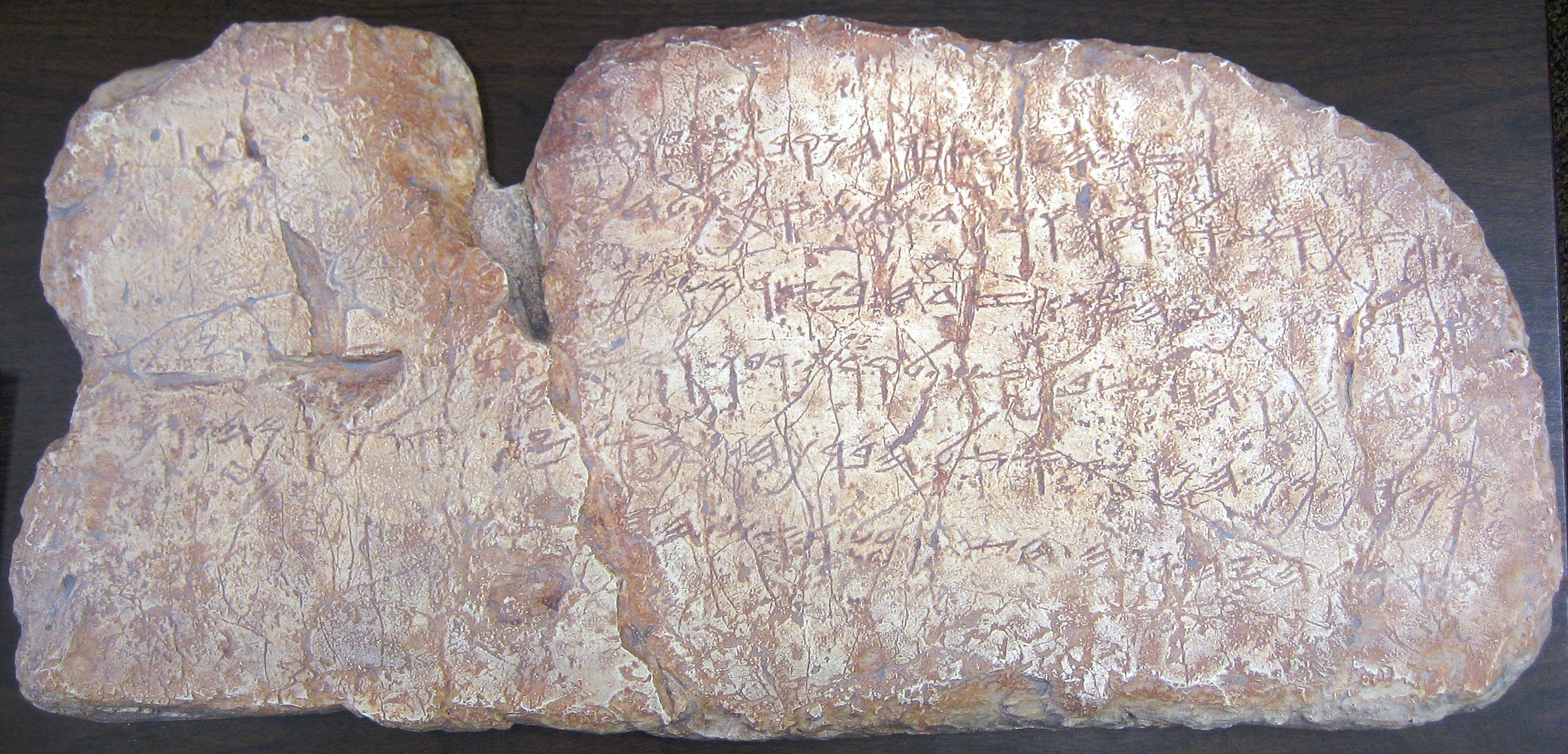
The Gezer Calendar (10th cent. B.C.) 

The Gezer Calendar inscription is a small (about 5 1/2 inches by 2.5 inch by 5/8 inch thick) inscribed limestone block discovered at Gezer by by R.A.S. Macalister in 1908.
 Gezer was one of the few ancient cities that actually had its name written on rocks at its city limits. That's how we can be reasonably certain that the rock comes from this Biblical city.

The archaeological context of the rock is a bit vague because Macalistar worked in a time when dating by soil layers (Soil Stratigraphy) hadn't been discovered yet.


Readers might recognize the shapes of some of our letters in this inscription. P and W and Z kind of stand out, even though the P is backwards and is actually equivalent to our "R". The W is actually pronounced "sh." And the funny Z with the extra vertical stroke on the left is pronounced something like "ts." The O doesn't have an equivalent in English but is something akin to choking on steak and trying to say the the letter G. The Y stands for the sound we make with W. The circle split down the middle to look like a backward P attached to a P is the letter Q. The little triangle is the letter D. The letter that looks like a sideways M with an extra leg is an M. The letter that looks like H with a bar at the top and bottom is pronounced "ch" like when you showed your mom something gross and she said "Ach! Put that away!" You get the idea.

from Joseph Naveh's book
Early History of the Alphabet.
 And there are no vowels written down: just consonants.

Spaces added            Transcribed
 ירחו אסף ירחו ז
רע ירחו לקש
ירח עצד פשת
ירח קצר שערם
ירח קצר וכל
ירחו זמר
ירח קץ
אבי
 ירחואפירחוז
רעירחולקש
ירחעצדפשת
ירחקצרשערמ
ירחקצרוכל
ירחוזמר
ירחקצ
אבי

Here is a transliteration of what it might have sounded like and then a translation.

(1) Yarchew asip. Yarchew ze-
(2) ra. Yarchew liqsh.
(3) Yarcho atsid pisht.
(4) Yarcho qtsir se'orim.
(5) Yarcho qtsir wakil.
(6) Yarchew zamir.
(7) Yarcho qets.
And the vertical writing at the bottom left: "Abiy."

The possible translation:

(1) There are two months of harvest. There two months of sow-
(2) ing. There are two months of planting.
(3) There is a month of cutting flax.
(4) There is a month of harvesting barley.
(5) There is a month of harvest and finishing.
(6) There are two months of vinedressing.
(7) There is a month of summer fruit.
And the vertical writing might by a name: "Abi" or "my Dad", or it could have been "Abijah" if the final letter is missing.

The Gezer Calendar shows at least these important things with regard to our reading of the Bible:
  • Hebrew was written even for farming.  Thus as a written language the Hebrew text of the Bible was not inaccessible due to any conjectured social limitations modern scholars might project back upon ancient Israel.
  • No vowels were used--not even a mater lectionis (more below). This means, in part, that the people who read it were familiar with the text and how to read it out loud. Ths s nt s hrd s y mght thnk.
  • There were no spaces between words. Bttdsmplythtthywrsklldrdrs.
  • Words were broken from one line to the next.
  • All the letters are of the same case. That is, there is no distinction between upper-case and lower-case letters. THTSSMWHTHRDRTRD.
This example is written right to left  like most North West Semitic inscriptions--though we do have other examples of left to right and even boustrophedon (great word, isn't it! It means "as the ox plows" to describe writing that goes left-to-right on one line then right-to-left on the next.)

In English, using the writing conventions of the Gezer Calendar the first verses of Genesis might look like this:
NTHBGNNGGDCRTDTHHV
NSNDTHRTHNDTHRTHWS
WTHTFRMNDVDNDDRKNS
SWSPNTHFCFTHDPNDTHS
PRTFGDHVRDPNTHFCFTH
WTRS


Tel Dan Inscription (9th cent. B.C.)
The Tel Dan Inscription comes from the site of Tel Dan in Northern Israel. It was discovered during the 1993-94 excavation season. It is an Aramaic inscription (closely related to Hebrew, parts of the Bible are in Aramaic). The inscription shows some ways in which writing improved so that it was easier to learn and to read.

The highlighted text in the picture above are the letters BTDWD which translate as "House of David." This is the earliest known reference to King David outside the Bible. And the reference is hotly contested because so much scholarship today has been geared at undermining trust that David even existed as a person.


The transcription of the Tel Dan Stele made by Biran and Naveh
English Transcription
1'. [ ]...[ ] and cut [ ]
2'. [ ] my father went up [ ] he fought at [...]
3'. And my father lay down; he went to his [fathers]. Now the king of I[s]/rael had penetrated
4'. into my father's land before. [But then] Hadad made me king,
5'. And Hadad marched before me. So I went forth from [the] seven[...]/s
6'. of my rule, and I killed [seve]nty kin[gs] who had harnessed thou[sands of cha]/riots
7'. and thousands of cavalry. [And I killed ...]ram son of [...]
8'. the king of Israel, and I killed [...]yahu son of [... the ki]/ng of
9'. the House of David. And I made [their towns into ruins and turned]
10'. their land into [a desolation ...]
11'. others and [...Then...became ki]/ng
12'. over Is[rael...And I laid]
13'. siege against [...]
1.[ ]א]מר.ע[ ]וגזר ]
2.[ ]אבי.יסק[.עלוה.בה]תלחמה.בא--- ]
3.וישכב.אבי.יהך.אל[.אבהו]ה.ויעל.מלכי[ יש]
4.ראל.קדם.בארק.אבי[.ו]יהלך.הדד[.]א[יתי]
5.אנה.ויהך.הדד.קדמי[.ו]אפק.מן.שבע[ת---]
6.י.מלכי.ואקתל.מל[כן.שב]ען.אסרי.א[לפי.ר]
7.כב.ואלפי.פרש.[קתלת.אית.יהו]רם.בר[אחאב.]
8.מלך.ישראל.וקתל[ת.אית.אחז]יהו.בר[יהורם.מל]
9.ך.ביתדוד.ואשם.[אית.קרית.הם.חרבת.ואהפך.א]
10.ית.ארק.הם.ל[ישמן ]
11.אחרן.ולה[... ויהוא.מ]
12.לך.על.יש[ראל... ואשם.]
13.מצר.ע[ל. ]

The inscription has noticable dots between words. These are word dividers.


Similar word dividers can be seen in the Mesha Stele, a Moabite inscription from the East side of the Jordan that dates to about 850 B.C. The Moabite Stele describes Jehoram's alliance with Jehoshaphat against king Mesha of Moab (2 Kings 3:4-8), but from Mesha's royal perspective.

Siloam Inscription
Word dividers are also visible in the Siloam Inscription (image), the dedication to King Hezekiah's water supply tunnel as recorded in 2 Kings 20:20 “And the rest of the events of Hezekiah and all his mighty deeds, and how he made the conduit and the pool, and he brought the water into the city, they are written in the book of the chronicles of the kings of Judah.”

More is recorded in 2 Chronicles 32:3-4.
 “And he took counsel with his officers and his mighty men to stop up the waters of the fountains that were outside the city, and they assisted him. And a large multitude gathered and stopped up all the fountains and the stream that flowed in the midst of the land, saying, "Why should the kings of Assyria come and find much water?""

The Siloam Inscription translates as:
... the tunnel ... and this is the story of the tunnel while ...
the axes were against each other and while three cubits were left to cut? ... the voice of a man ...
called to his counterpart, (for) there was ZADA in the rock, on the right ... and on the day of the
tunnel (being finished) the stonecutters struck each man towards his counterpart, ax against ax and flowed
water from the source to the pool for 1200 cubits. and 100?
cubits was the height over the head of the stonecutters ...
Beside the interesting historical information about Hezekiah's tunnel, and giving us some everyday history, this inscription with the others listed show us how the text of the Bible had been recorded to make reading the text easier.

In English, using the writing conventions of these inscriptions the first verses of Genesis might look like this:
N TH BGNNG GD CRTD TH HV
NS ND TH RTH ND TH RTH WS
WTHT FRM ND VD ND DRKNS
S WS PN TH FC F TH DP ND TH S
PRT F GD HVRD PN TH FC F TH
WTRS
The word dividers are a very significant improvement. However, using a sign like the dot in these inscriptions, means that words can still be split. This leaves one or more letters on one line and the rest of the letters of a word on the next.

In the next article we will look at some of the developments in writing we can learn from the Ketef Hinnom Inscriptions, the Mousaieffe Inscriptions, the Lachish Letters, and then from the Dead Sea Scrolls.

After that we will look at what we can learn from Greek Manuscripts and Inscriptions of the New Testament.