Showing posts with label Bible Study. Show all posts

Wednesday, July 16, 2014

Non-Lutheran Bible Studies? What's the Harm?

From Issues, Etc.
1. The Danger of Non-Lutheran Bible Studies – Pr. Anthony Voltattorni, 7/15/14
Pastor Anthony Voltattorni of Zion Lutheran-Marshall, MI


Wednesday, June 25, 2014

The Three Outposts, Your Mission: Study 8


Church and State

Prayer: O Jesus Christ, Son of the living God, You have given us Your holy Word and have bountifully provided for all our earthly needs: We confess that we are unworthy of all these mercies, and that we have rather deserved punishment. But we beseech You, forgive us our sins, and prosper and bless us in our various callings, that by Your strength we may be sustained and defended, now and forever, and so praise and glorify You eternally; for You live and reign with the Father and the Holy Spirit, one true God, now and forever. Amen.

How are these outposts confused?
These outposts are confused when the responsibilities and authority of one outpost are mixed with or usurped by another.

Review the kinds of authority God gave to each of these outposts.

Confusion of The Three Estates in Political Philosophy and Literature
First, the term "Three Estates" has been used in both popular literature and political discussions throughout history. The terminology of the Three Estates comes to us from the background of Medieval Feudalism. In that context it referred to the Clergy, the Nobility, and the Commoners. There were authors

The Three Outposts, Your Mission: Study 7


State and Home

Prayer: Lord Jesus, abide with us. Make our homes the dwelling places of Your continual presence, and keep us faithful to You and Your Word. Let the joy of the Gospel dwell in our hearts. Let our daily conversations be hallowed and pleasing and acceptable to You. Preserve us from sin. Be with us in the hour of temptation. Keep us unworried and untroubled. Remove from our lives all unbelief and indifference. Strengthen our faith, deepen our love to You, and make us consecrated people who day after day bring all our cares, concerns, joys, and sins to You in prayer. Let your blessing be upon our families and our nation. Grant our nation peace, and safety. Give our president, governors, representatives, judges, and all officers of the civil state Your spirit of wisdom and fear, that we may live our lives in quiet godliness for the glory of Christ and the benefit of Your Church. In Christ's holy Name we ask this. Amen.

How are these outposts confused?
These outposts are confused when the responsibilities and authority of one outpost are mixed with or usurped by another.

Review the kinds of authority God gave to each of these outposts.

Some questions for discussion:

Does being a father and husband mean that a man has the divine responsibility to ensure that his neighbor is giving his kids enough exercise?

The Three Outposts, Your Mission: Study 6


Church and Home

Prayer: Almighty God, You have given us grace at this time with one accord to make our supplications to You, and have promised that wherever two or three are gathered together in Your name, you will grant their requests: Fulfill now, O Lord, the desires and petitions of Your servants, as may be most expedient for them; grant us in this world knowledge of Your truth, and in the world to come life everlasting. Amen.

How are these outposts confused?
These outposts are confused when the responsibilities and authority of one outpost are mixed with or usurped by another.
Review the kinds of authority God gave to each of these outposts.

Some questions for discussion:

Can a man, simply because he is a husband and a father and therefore God's representative, decide that he can preach to the congregation at their regular worship?

The Three Outposts, Your Mission: Study 5


Third Outpost: The State (Civil Governance)


Prayer: Lord God, heavenly Father, We thank You that unto this time You have granted us peace and graciously spared us from war and foreign dominion. We pray, graciously let us continue to live in Your fear according to Your will, giving no cause for wars or other punishment; govern and direct our leaders, that they may not hinder the obedience due to You, but maintain righteousness, that we may enjoy happiness and blessing under their government; through our Lord Jesus Christ, who lives and reigns with You and the Holy Spirit, one true God, now and forever. Amen.

Review the Fourth Petition of the Lord's Prayer as well as the Meaning and “What is meant by daily bread?”
A very popular American false doctrine was authored by Thomas Paine in his book Common Sense. He wrote “society in every state is a blessing, but government, even in its best state, is but a necessary evil.”

But God calls civil governance “good” even though the people holding positions of authority are sinners, some believers, most unbelievers—and even if an evil tyrant is the head of government he is still to be revered as God's servant, prayed for, and obeyed (for example, Consider Daniel, or God's use of the Medes Isaiah 13:17-22, His use of Assyria to punish Israel Isaiah 9:8-10:20, and many many more examples)

The State, also called Civil Government, was the third outpost established by God in this sinful world. Though civil government is filled by corrupt sinful men,

The Three Outposts, Your Mission: Study 4


The Second Outpost: The Church (Ecclesiastical Governance)

Prayer: Lord God, heavenly Father, we most heartily thank You that You have caused us to come to the knowledge of Your Word. We pray: Graciously keep us steadfast in this knowledge unto death, that we may obtain eternal life; send us, now and ever, pious pastors who faithfully preach Your Word, without offense or false doctrine, and grant them long life. Defend us from all false teachings, and frustrate the counsels of all who pervert Your Word, who come to us in sheep's clothing, but inwardly are ravenous wolves, that Your true Church may evermore be established among us, and be defended and preserved form such false teachers; through our Lord Jesus Christ, Your Son, who lives and reigns with You and the Holy Spirit, one true God, now and forever. Amen.

Read the Third Article of the Creed and its Meaning, refer to Chapter 24 in the Catechism Explanation.

The Church is the second outpost or estate that God established here on earth.

Why did God establish the Church?
Read John 1:12-14: The Church consists of all those who through faith in Jesus Christ, His Son, God the Father reckons as His own children. This faith is a gift of God (Ephesians 2:9-11) which trusts in His Promise of forgiveness so that we might again be reconciled to the Father and live with Him eternally (Colossians 1:19-23).

The Three Outposts, Your Mission: Study 3


The First Outpost: The Home (Domestic Governance)


Prayer: Lord God, heavenly Father, we thank You, that by Your grace you have instituted holy matrimony, in which You keep us from unchastity, and other offenses: We beseech You to send Your blessing upon every husband and wife, that they may not provoke each other to anger and strife, but live peaceably together in love and godliness, receive Your gracious help in all temptations, and raise their children in accordance with your will. Grant that we all might walk before You in purity and holiness, put our trust in You, and lead such lives on earth, that in the world to come we may have everlasting life, through your beloved Son, Jesus Christ, our Lord, who lives and reigns with You and the Holy Spirit, one true God, now and forever. Amen.

Review The First Article of the Creed and its Meaning, refer to chapter 16 in the Catechism Explanation.

The Household Estate, or the Family is the first relationship with other people that God created.

Why did God establish the Household estate?
Genesis 1:26-31, notice the emphasis on the complete image of God in parallel with the fact that he made humans as male and female for each other. As God is the Creator and Ruler of Heaven and Earth, what abilities and responsibilities did He give to humans that reflect His image?

The Three Outposts, Your Mission: Study 2


The Three Outposts Through the Bible

Prayer: O almighty, eternal God: We confess that we are poor sinners and cannot answer one time out of a thousand, when You contend with us; but with all our hearts we thank You, that You have taken all our guilt from us and laid it upon Your dear Son Jesus Christ, and made Him to atone for it. We pray, graciously sustain us in faith, and so govern us by Your Holy Spirit, that we may live according to Your will, in neighborly love, service and helpfulness, and not give way to wrath or revenge, that we may not incur Your wrath, but always find in You a gracious Father; through Jesus Christ our Lord, who lives and reigns with You and the Holy Spirit, one true God, now and forever. Amen.

A History of the Three Estates in the Old Testament.

Creation and Fall
When God created Adam and Eve, Adam was the Spiritual, Civil, and Household authority. As spiritual authority he taught Eve how to regard the Tree of the Knowledge of Good and Evil. As Husband and Spiritual authority he failed by not protecting his wife from temptation and by eating of the fruit of the tree himself:

Read Genesis 3, notice the order of who did what. Then notice how God addresses each in order in the curse.

The promise was given in Genesis 3:15, and so the faith in the Messiah was established. This is the Church.

When Cain slew his brother Abel he realized that he should be punished by being

The Three Outposts, Your Mission: Study 1

[This the first session of an 8 session Bible study on the Three Estates. This series was used for the Evangelical Lutheran Synod's Camp Indianhead in the summer of 2013.]


Overview of The Three Estates

Prayer: Dear heavenly Father, we thank You through Your Son, Jesus Christ, that we have been called out of the darkness of sin into the light of grace and forgiveness by the power of Your Holy Spirit through Word and Sacrament. We confess that we cannot do any good of our own power or will and beg that You would grant us Your grace to live this life in the places where You have placed us. You have put us here in these outposts in life. You have given us the mission to love our neighbor as Christ has loved us. Grant us Your grace and work in us and through us what we cannot. We ask this in the name of our Brother, Jesus Christ, the Lord. Amen.

Introduction:
This series of Bible studies introduces God's teachings about Vocation, the Three Estates, and Christian Service. These teachings from God's Word are all interrelated with the basic article of the Christian teaching: that we are Justified by God through faith in Jesus Christ alone, none of our works have any saving merit before God. In this world, as sinners redeemed by the blood of Christ we have been called by God to faith in Christ through Word and Sacrament, placed in our outposts, our communities, congregations, and families by the providential grace of God, all so that the Light of Christ may shine before men. This, then, is the foundation upon which we seek to understand where God has placed us in our various outposts in this world and what our mission is through His Gospel and by His strength.

Saturday, August 03, 2013

Reading the Bible: What Can Ancient Inscriptions Teach Us? part 2

Making your reading of God's Word easier.

In the first article we looked styles of writing from Akkadian cuneiform, Ugaritic cuneiform, through the development of Proto-Sinaitic and Paleo-Hebrew.

As readers we grow up having been educated in the writing conventions of our language. For most of us we have very little appreciation for how much these rules help us by making reading and writing easier.

From the logographs [individual symbols representing words] and syllabaries [individual symbols representing the sound of a syllable] of cuneiform to the consonantal alphabet of Paleo-Hebrew we covered just a few improvements in writing. But those improvements are extremely important.

The introduction of alphabetic writing to replace logographs and syllabaries reduced the learning curve, increased literacy rates. Writers and readers no longer had to learn up to 400 different symbols to express their thoughts in the written word. The switch to alphabetic writing expanded the kinds of materials to use for writing. Clay was ideal for the cuneiform, rock could be inscribed. But with the development of a small alphabet even simple charcoal paint could be used on leather, papyrus, and random pieces of bark, rock or pottery.

The simplification of writing made literacy available to more than just a specially trained group of scribes. With wider literacy several significant social changes were able to take place.

We saw that alphabetic writing was used both for farm calendars as well as royal inscriptions.

The instructions of Deuteronomy 6:6-9 rest on the assumption of widespread literacy. These words are, in effect, a command that the people of God teach literacy to all their children for the sake of preserving God's written Word:

6 “And these words which I command you today shall be in your heart. 7 You shall teach them diligently to your children, and shall talk of them when you sit in your house, when you walk by the way, when you lie down, and when you rise up. 8 You shall bind them as a sign on your hand, and they shall be as frontlets between your eyes. 9 You shall write them on the doorposts of your house and on your gates.
In God's providence He fostered the development of the alphabetic script from the hieroglyphics of the Egyptians. What we seem to be able to say about the epigraphic evidence is that this development took place among Semitic peoples and the Phoenicians in areas under Egyptian rule and influence during the 400 years the children of Israel were sojourning in Egypt. From this evidence we might hazard to conjecture that God used this sojourn to prepare His church for the written word, giving them the tools to read and write in a simple alphabetic script -- and thus to preserve that written Word and teach it to every member of His people.

The writing methods we know about from the time of Moses imply a constant reading out loud of the Word of God so that those instructed knew where words started, how they were to be pronounced and so on. The evidence we have shows that the books of Moses (and probably of Job) were written in consonantal alphabets [called abjads today] without spaces or divisions between words.

The Phoenician letters which grew out of the Proto-Sinaitic script  became the standard for the early Hebrew and Aramaic writings as well-even though those two languages had more consonants than the 22 Phoenician letter system.

The introduction of the word divisions greatly eased the reading of the text, giving a visual clue to the start and end of each word. This took one more burden off of the reader, who would otherwise have to know the text fairly well before trying to read it aloud. The earliest evidence of word dividers we have found come from alphabetic cuneiform scripts like that of Ugarit, and from  Phoenician inscriptions at Byblos, both north of ancient Israel. For example:

[image from Promotora Espanola Alfabeto Fenicio arcaico]

the short vertical lines or dots in the inscription of Yehimilk from Byblos (c. 1000 B.C.)

and 
[image from Bibliotheque Trajan Alphabet phénicien]
  the dots between words in the late 9th cent B.C. stele of Kilamu king of Yadi. 

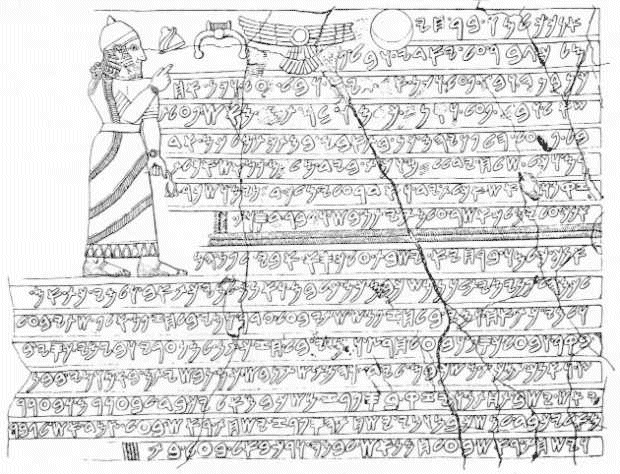
But the use of word dividers in Phoenician inscriptions was not universal, as can be seen in
[Image from Monuments of the Hittites: Karatepe]
the 8th cent. inscription in Karatepe North Gate East Wall.

There are many other improvements that were made.

There are several different examples of inscriptions that have been discovered that could be used to show how various features of writing developed. We will take a look at just a few as examples of how writing developed

The Lachish Letters (7th cent. B.C.)

 How they were found

Up to the time these inscriptions were found the only ancient Hebrew inscription of any length that was known was the Siloam Tunnel Inscription. The Samaria Inscriptions discovered in 1910 were basically trade/tax inventories, of historical value, but not really literary. The discovery of the Lachish Letters made historians aware of how Hebrew was written in non-Biblical literary contexts.

In the early months of 1935 J.L. Starkey was digging at Tell ed-Duweir, about 45 miles by road south-east of Jerusalem. Starkey had been in charge of this archaeological expedition from 1932. But that January 29th, 1935 the expedition hit the jackpot. Among the broken pottery found in the gate house of the city were 18 ostraca, 3 more were found in the 1938 expedition. But that year Starkey "was murdered by a party of armed Arabs on the track leading from Beit Jibrin to Hebron." (League of Nations Report find: Starkey) His co-worker Harry Torcyner (Hebrew name: Naftali Herz Tur-Sinai) published the original report on these ostraca in 1938. An additional ostracon was found by the 1968 expedition led by Yohanan Aharoni, published in 1975. (Hebrew transcriptions of the 22 available here) Then eleven more were discovered by David Usshishkin's team during their 1973-1994 expedition. The most recent publication and interpretation of all 33 ostraca is in Andre Lemaire's 2004. “Ostraca and Incised Inscriptions” in chapter 29, section A of The Renewed Archaeological Excavations at Lachish (1973-1994) volume IV, ed. David Ussishkin. (Tel Aviv)

What are the Lachish Inscriptions?

The Lachish letters are ostraca: broken pieces of pottery reused for writing notes or letters. The ink was made of carbon and iron, probably mixed from lampblack. The pen is described by Roland de Vaux as a stylus with a broad but thin tip that needed frequent trimming with a knife, which the scribe neglected at some points in Letter III. ["Les Ostraka de Lachis," Revue Biblique, 48(1939), p. 183]

The archaeological context, the content of the letters, and the style of handwriting place these letters at a time just before the fall of Jerusalem to Nebuchadnezzar in 589/8 B.C. Before the letters were discovered most archaeologists believed that another location, Tel Hasi, was biblical Lachish. With the discovery of the letters and several other finds at Tell ed-Duweir, people began to realize some of the biblical and historical significance of the site.

The ostraca are letters or transcriptions of letters sent from one person to another. There has been debate on whether the ostraca are the original letters, whether they are practice drafts, or are simply transcriptions of letters received. (Hans Barstad, "Lachish Ostracon II And Ancient Israelite Prophecy," Eretz-Israel 24(1993):9*-10*)

There are three features we should bring out about these letters.
1) They show an early use of letters as vowels.
2) The content of some of the letters is evidence of a presumed literacy.
3) They were written with pen and ink quickly.

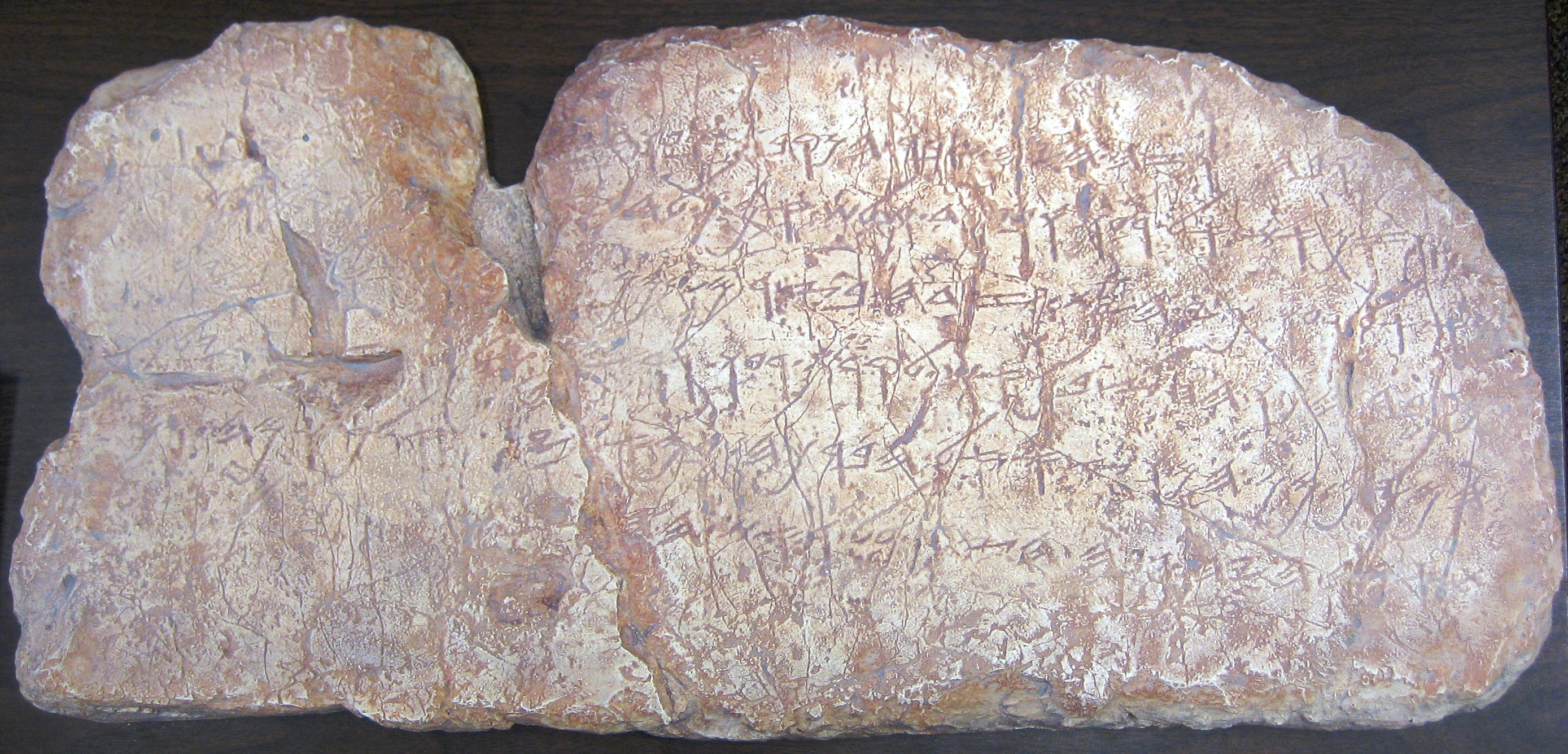
The following images are of a museum reproduction of Lachish Letter III crafted to make it easier for students to see the letters. Some of the letters on the original were only visible via special lighting and photography.
Front Side
[Image from מכתבי לכיש]

Reverse Side
[Image from מכתבי לכיש]


עבדך הושעיהו שלח ל
1 Your servant Hosha'yaho has sent to
הגד לאדני יאוש. ישמִעַ
2 tell my lord Ya'ush: May
יהוה את אדנִי שמֻעת שלֹם
3 the LORD let my lord hear tidings of peace
ושמֻעַת טֹב ועתָ, הַפְקַח
4 and tidings of good. And now open
נא אֶת אֹזֶן עבדךָ לַסֵפֶר אשר
5 please the ear of your servant to the letter which
שלחתה לעבדך אמש. כי לֵב
6 you sent to your servant yesterday for the heart
עבדך דָוֵה מאז שלחֶךָ אל עבד
7 of your servant is sick since you have sent to your servant
ךָ. וכי אמר אדנֹי: "לא ידעתה
8 and because my lord says, “Do you not know
קרא ספר". חַיהוה אם נסה א
9 how to read a letter?” As the LORD lives if any man has tried
יש לקרא לי ספר לנצח. וגם
10 to read me a letter ever! And the same for
כל ספר אשר יבא אלי, אם
11 every letter which comes to me, if
קראת אתה, ועוד אֶתנֶנהוּ
12 I should read it. Furthermore I would put it down
אל מאוּמ[ה]. ולעבדך הֻגַד
13 to nothing. And to your servant it has been reported
לאמֹר ירד שר הצבא
14 saying “The commander of the army has gone down,
כניהו בן אלנתן לבֹא
15 Konyahu son of Elnatan, to go
מצרימה ואת
16 to Egypt and
-------side 2----


הוֹ‏דַוְיָהוּ בן אחיהו ו
17 Hodawyahu son of Ahiyahu and
אנשָו שָלַח לקחת מזה.
18 his men he has sent to take from here.
וספר טֹביהוּ עבד המלך הבא
19 And the letter of Tobiyahu, the servant of the king, who came
אל שלם בן ידע מאת הנבִא לאמ
20 to Shallum the son of Yaddua, from the prophet to say
ר: "הִשמֵר"! שלָחֹה עב[ד]ך אל אדנִי
21 “Beware!” your servant is sending it to my lord.

[The transcription and vocalization is based on Tur-Sinai and Achituv.]

1. Development of Vowel Letters

One of the main developments this inscription shows in comparison with earlier epigraphic texts is the fuller and commonly accepted use of some consonants as vowels. While the occasional use of a consonant as a vowel can be seen quite early in the inscriptions, at this point in the development of the language the 'aleph א, he ה, yod י, and waw ו  were used as vowels not only occasionally at the ends of words but frequently and even in the middle of words to help the reader understand how to pronounce the words. For example the word "man" איש 'ish is written with the yod in lines 9-10.

Though there were not yet vowels written for every syllable, what this meant for readers of the Bible is that the common spellings in Hebrew at this point included not just the consonants of the words, but in some places there were vowels written also. This made understanding the text and reading out loud easier.

The full use of vowels in the text would not come until much much later with the introduction of vowel points (Nikkudim) in three different systems we know of: The Tiberian, the Babylonian, and the Palestinian traditions. (for more read the Jewish Encyclopedia on Vocalization)


2. Literacy Presumed

Since these letters were discovered there has been debate about whether to interpret the text as saying that the servant is claiming to be illiterate [Torcyner] or that he is defending his ability to read [F.M. Cross].

The translation above follows Torcyner's interpretation that the servant is defending his inability to read. If this is the case, then the presumption of his master was that he thought his servant was reading the letters he was sending.

Frank Moore Cross interpreted the text as the servant's defence of his ability to read instructions carefully. If this is correct, then the literacy of the servant is still the presumption of his master, but the master is disappointed that the servant failed to follow instructions properly. Reading the same consonantal text Cross understands lines 8-13 as saying:
and that my lord said, "you did not understand it.
Call a scribe!" As Yahweh lives, no one has tried
to read a letter to me ever, and furthermore,
any scribe who might have come to me, I did not
summon him and, further, I would pay him
nothing!
[F.M. Cross, "A Literate Soldier: Lachish Letter III" in Kort and Morschausen Biblical and Related Studies Presented to Samuel Irwy, Winona Lake, Eisenbrauns 1985, pp. 41-47]

In either case, the letter points out that at the time just before the Babylonian Exile (589/8 B.C.) literacy was not limited strictly to a group of scribes but could be presumed of servants and soldiers. Letters were written out, either as they were composed or as they were recited by a military courier who had memorized them for secrecy. [Yigal Yadin "The Lachish Letters--Originals, Copies, or Drafts?" in Recent Archaeology in the Land of Israel, Shanks and Mazar, Washington D.C. 1984, pp. 1979-186, see Biblical Archaeology Review 10:2 (1984) pp. 774-777]

3. Writing Quickly 

The ability to read well, however, is not the same as the ability to write legibly. Nor does the ability to write mean that a person can do so quickly. Combining both legibility and speed is a commodity in any literate society. This letter was probably written by a professional scribe rather than by the servant. Because of the similarity in handwriting this scribe also appears to have transcribed the majority of the first set of ostraca discovered.

Some readers might have a romanticized image of a scribe: a middle aged or old man sitting over parchment laboriously copying documents, back bent from years of labor, fingers stained from ink. Perhaps there were scribes that more or less fit that image. The location of the ostraca at the city gates, the fact that ostraca II, VI, VII, VIII and XVIII came from the same pot [de Vaux, "Les Ostraka De Lachish," p. 183; Torcyner et al. Lachish I-The Lachish Letters, Oxford U. Press, 1938, p. 220], the variety of their content, and the similarity of handwriting for most of the letters suggest a couple of observations.

This scribe conducted his trade at the city gate where communiques and other correspondence would enter and leave the city. One of the ostraca, XVII, was re-used after being washed or rubbed out. [de Vaux p. 184] His neat and clear handwriting style shows good uniformity and signs of quick writing. The texts themselves show a diversity of subjects from lists of names to official correspondence. And in this correspondence we have testimony that the name of God, Yahweh, was invoked for blessing and oaths, and that an unnamed prophet was referenced.

There is a possible related Biblical event, though this may just be coincidence. Jeremiah 26 records the name of an Elnathan. In Jeremiah this Elnathan was sent to Egypt to go after a prophet who spoke the warnings of the Lord in accordance with Jeremiah:
20 Now there was also a man who prophesied in the name of the Lord, Urijah the son of Shemaiah of Kirjath Jearim, who prophesied against this city and against this land according to all the words of Jeremiah. 21 And when Jehoiakim the king, with all his mighty men and all the princes, heard his words, the king sought to put him to death; but when Urijah heard it, he was afraid and fled, and went to Egypt. 22 Then Jehoiakim the king sent men to Egypt: Elnathan the son of Achbor, and other men who went with him to Egypt. 23 And they brought Urijah from Egypt and brought him to Jehoiakim the king, who killed him with the sword and cast his dead body into the graves of the common people.
While we can not say that this is the same event, there certainly is a strong similarity. And the ability to write legibly and quickly was an important commodity useful not only in the area of teaching the Bible but also in official state correspondence.

Next Time...

Well, originally I had planned on a series of 3 articles on this topic, but each article would be very long. So I will be splitting them up into a few more.

God willing, we will look at the The Mousaieff and Ketef Hinnom Inscriptions next time and then the transition to the Aramaic alphabet after the Babylonian Exile. Following that we will look at the development of Greek writing to see how our writing conventions changed and became more structured as well as easier to read.

Wednesday, July 24, 2013

Reading the Bible: What Can Ancient Inscriptions Teach Us? part 1 of 3

Making your reading of God's Word easier.


Some people object to underlining, highlighting, or otherwise marking in the text of their Bibles. The purpose of this series of articles is to demonstrate some note taking methods and highlighting methods that can help in reading the Bible. The methods we will cover build upon the history of how the text of the Bible has been preserved for us to this day.

This first article focuses on how writing text was done at the different points in history when the Scripture was given. This is not a historical-critical approach. What we will look at here is how writing using letters rather than ideograms or logograms made the Biblical text accessible to the everyday person. We will also look at how formatting the text developed to make reading even more accessible to readers.


Ancient Writing Systems and the Bible:

It is both fun and helpful to see how the original texts were preserved through the ages. Seeing how it was preserved can also help us learn how to build a note-taking and highlighting system that preserves the original text in its own context.

As far as we know, we do not have any of the original manuscripts of the Scriptures. What we can do is look at how the Bible was likely to be written at the times God inspired the original writers. The alphabet used in modern Hebrew Bibles is the Imperial Aramaic alphabet which dates from the 5th century B.C.

For a more thorough introduction to the writing systems of the Ancient Near East check out: Joseph Naveh, Early History of the Alphabet. 2nd ed, 1997. 

The two earliest texts in the Bible are the Books of Moses and, possibly, Job.

We base our understanding of when Moses wrote his five books, the Pentateuch, on the dates given to us in Scripture.

The Hebrew text of I Kings 6:1 says “And it came to pass in the four hundred and eightieth year after the children of Israel had come out of the land of Egypt, in the fourth year of Solomon’s reign over Israel, in the month of Ziv, which is the second month, that he began to build the house of the Lord.”

This puts the year of the Exodus at approximately 1,440 B.C. The Exodus took place over 40 years of wandering, during which Moses wrote down the books of Genesis, Exodus, Leviticus and Numbers. At the end of that wandering he recorded his final sermons to the people of Israel just before they entered the promised land. This is the book of Deuteronomy.

The book of Job is a bit more difficult to date. Throughout the history of the Church different opinions have been offered about when this book was written. The earliest suggestions place the book back to the Patriarchal period, sometime around the period of Abraham. This could put the book of Job back at 2,000 B.C. or on down to much later. We will consider the earlier dates for the sake of demonstrating the ways in which Job's words might have been written down, carved in rock and filled with lead (19:23-24) or on clay or on leather.


Writing in the Ancient Near East before 2,000 B.C. and later:

Amarna Letter EA 161
Cuneiform was a style of writing embraced by a wide variety of very different languages: Sumerian, Elamite, Hattic, Hurrian, Urartrian, Luwian, Hittite, Old Persian. It was also used for languages more closely related to Hebrew: Ugaritic, Eblaite, and Akkadian (Assyrian and Babylonian). The use of this style of writing ranges from the early styles at 3,300 BC down to the 1st century A.D.

Cuneiform means “wedge shaped, ” (Latin cuneus "wedge,"). The symbols and their uses varied from one linguistic group to the next, but the process was very similar: a stylus was used to press wedge or round shapes into soft clay. The clay then might be baked to make the writing permanent.

Many cuneiform systems consisted of logograms (symbols which represent a word in a language) and a syllabary (symbols which represent a combination of a consonant and the following vowel sound). Some of the symbols functioned both as a logogram and as a syllable, depending on context. Some of the syllable signs could act as more than one different combination of consonant and vowel, depending upon context.

Transcribing from the clay tablets to represent the symbols would give us something like this:


In this text there are no divisions or spaces between words, there is no punctuation, there are no paragraphs, or other types of markers to help the reader read the text.

What just a few of these Akkadian symbols represent as sounds or syllables:


(both images from http://www.omniglot.com/writing/akkadian.htm)

If Job were originally written in this style of writing, the text we have would have been transcribed from the Akkadian cuneiform symbols into either the Paleo Hebrew alphabet or possibly the Proto-Sinaitic/Proto-Canaanite alphabet.(http://www.omniglot.com/writing/protosinaitc.htm)

The result of transcription is that a person only needed to know 22 letters in the Paleo-Hebrew alphabet in order to read a text. This compares to having to learn somewhere between 200 and 400 symbols in order to read the Akkadian cuneiform symbols.

The city-state of Ugarit developed a 31 symbol system using cuneiform characters but limited to specific consonantal sounds like that of the Phoenician or Paleo-Hebrew alphabets. It also incorporated a new feature, a special mark to divide between words. Ugarit used this “alphabetical cuneiform” from the 14th century B.C. until the city's destruction in the 12th century B.C.

From this we can understand that if the book of Job were originally written in Akkadian cuneiform or Ugaritic cuneiform there would have been no problem accurately transcribing the text from either possible source scripts in the Paleo-Hebrew script.

In English, using the writing conventions of the Akkadian cuneiform syllabary the first verses of Genesis might look like this: (using ' to signal a stop of breath and start it again--remember, each syllable was its own unique sign, though there were no spaces between words in Akkadian cuneiform, we use spaces here to separate the signs for individual syllables. The same sign would be used for the same syllable)
'I NU THE BE GI NI NGU GO DU CA RE 'A TE DA
THE HE VA NA SA 'A NA DA THE 'E RU THA 'AN
DA THE 'E RU THA WA SU WI THO TA FO RU MA
'A NA DA VO YA DA 'A NA DA DA RU KA NE SA
WA SA 'U PO NA THE FA SA 'O FA THE DE PU 'AN
DA THE SA PI RI TU 'O FA GO DU HO VE RE DA
'U PO NA THE FA SA 'O FA THE WA TA RA SU

In fact, transliterating the texts from cuneiform to Paleo-Hebrew would have greatly eased the learning of reading and writing by reducing complexity, length of leaning, and would have the added value of increasing the types of material usable for continued preservation of the text from one generation to the next. 

The Proto-Sinaitic Script

These alphabets referred to by the term “abjad”—a shorthand for an alphabet system made up of consonantal symbols but not vowels. If Job was written sometime between 1,700-1,200 B.C. the book could have been written in the Proto-Sinaitic Script, also called Proto-Canaanite. This alphabet consisted of about 30 symbols.

The script appears to have been based on Egyptian Hieroglyphics. However, the sound of each symbol appears to be based on initial sound of the Hebrew/Semitic name for the symbol rather than the sound of the Egyptian name. (http://asorblog.org/?p=427, Naveh, Early History of the Alphabet, pp. 23-42)

What is interesting to me about the historical development of this script is that the examples we have are contemporary with when the Bible describes the exile of Israel to Egypt for 430 years.
Wadi el-Hol Inscription

During this period of Biblical history in areas of Egypt's influence (where one would not be surprised to find Hebrew speaking people) we find these inscriptions using Hebrew sounds attached to Egyptian symbols spelling out Hebrew words. ( Article on the process )

There are not very many Proto-Sinaitic inscriptions found as of yet. Most of the inscriptions are found in the Sinai, Middle-Egypt, a copper mine at Timna in southern Israel, and a very few found in the Canaan region itself.
Drawing of Wadi el-Hol Inscription

The inscriptions vary from being possible instructional signs at the Timna mines  to what appears to be a religious expression, possibly pagan, at Wadi el-Hol (between Thebes and Abydos at Qena bend of the Nile).

Some of the symbols were probably used as logograms, like abbreviations: for example, the letter M was the symbol of water, the name for the letter was the word for “water” and would make a very suitable short-hand easily understood on the lid of a water jar.

It is impossible to say whether or not this type of writing would have been used for the book of Job. We just don't have enough surviving examples to know if it were used for literary texts.

However, the symbols and their use are very close to that of Paleo-Hebrew characters, all the letters of the Hebrew language appear to have an equivalent in this Proto-Sinaitic/Proto-Canaanite script. And quite a few of those letters have the same basic shapes.


Paleo-Hebrew Script

We are certain that this particular abjad script was used for the Bible. The reasons for this are:
  1. This script was in use throughout Canaan and the surrounding area for many Semitic languages from about 1,200 B.C. down to 137 A.D.
  2. It was in common use for inscriptions, letters, notes, lists, seals, jewelry, and epigrams. It was not limited to a scribal class.
  3. We have examples of Bible texts written in this script from at least as early as the 7th century BC.

The features of each inscription give us examples of how writing was done in those times. This teaches us both about the preservation of the Biblical text as well as the ways in which the use and formatting of language changed to make the reading of the text easier and more accessible through the generations.

Our first two examples come from the 10th and 9th centuries B.C. 

The Gezer Calendar (10th cent. B.C.) 

The Gezer Calendar inscription is a small (about 5 1/2 inches by 2.5 inch by 5/8 inch thick) inscribed limestone block discovered at Gezer by by R.A.S. Macalister in 1908.
 Gezer was one of the few ancient cities that actually had its name written on rocks at its city limits. That's how we can be reasonably certain that the rock comes from this Biblical city.

The archaeological context of the rock is a bit vague because Macalistar worked in a time when dating by soil layers (Soil Stratigraphy) hadn't been discovered yet.


Readers might recognize the shapes of some of our letters in this inscription. P and W and Z kind of stand out, even though the P is backwards and is actually equivalent to our "R". The W is actually pronounced "sh." And the funny Z with the extra vertical stroke on the left is pronounced something like "ts." The O doesn't have an equivalent in English but is something akin to choking on steak and trying to say the the letter G. The Y stands for the sound we make with W. The circle split down the middle to look like a backward P attached to a P is the letter Q. The little triangle is the letter D. The letter that looks like a sideways M with an extra leg is an M. The letter that looks like H with a bar at the top and bottom is pronounced "ch" like when you showed your mom something gross and she said "Ach! Put that away!" You get the idea.

from Joseph Naveh's book
Early History of the Alphabet.
 And there are no vowels written down: just consonants.

Spaces added            Transcribed
 ירחו אסף ירחו ז
רע ירחו לקש
ירח עצד פשת
ירח קצר שערם
ירח קצר וכל
ירחו זמר
ירח קץ
אבי
 ירחואפירחוז
רעירחולקש
ירחעצדפשת
ירחקצרשערמ
ירחקצרוכל
ירחוזמר
ירחקצ
אבי

Here is a transliteration of what it might have sounded like and then a translation.

(1) Yarchew asip. Yarchew ze-
(2) ra. Yarchew liqsh.
(3) Yarcho atsid pisht.
(4) Yarcho qtsir se'orim.
(5) Yarcho qtsir wakil.
(6) Yarchew zamir.
(7) Yarcho qets.
And the vertical writing at the bottom left: "Abiy."

The possible translation:

(1) There are two months of harvest. There two months of sow-
(2) ing. There are two months of planting.
(3) There is a month of cutting flax.
(4) There is a month of harvesting barley.
(5) There is a month of harvest and finishing.
(6) There are two months of vinedressing.
(7) There is a month of summer fruit.
And the vertical writing might by a name: "Abi" or "my Dad", or it could have been "Abijah" if the final letter is missing.

The Gezer Calendar shows at least these important things with regard to our reading of the Bible:
  • Hebrew was written even for farming.  Thus as a written language the Hebrew text of the Bible was not inaccessible due to any conjectured social limitations modern scholars might project back upon ancient Israel.
  • No vowels were used--not even a mater lectionis (more below). This means, in part, that the people who read it were familiar with the text and how to read it out loud. Ths s nt s hrd s y mght thnk.
  • There were no spaces between words. Bttdsmplythtthywrsklldrdrs.
  • Words were broken from one line to the next.
  • All the letters are of the same case. That is, there is no distinction between upper-case and lower-case letters. THTSSMWHTHRDRTRD.
This example is written right to left  like most North West Semitic inscriptions--though we do have other examples of left to right and even boustrophedon (great word, isn't it! It means "as the ox plows" to describe writing that goes left-to-right on one line then right-to-left on the next.)

In English, using the writing conventions of the Gezer Calendar the first verses of Genesis might look like this:
NTHBGNNGGDCRTDTHHV
NSNDTHRTHNDTHRTHWS
WTHTFRMNDVDNDDRKNS
SWSPNTHFCFTHDPNDTHS
PRTFGDHVRDPNTHFCFTH
WTRS


Tel Dan Inscription (9th cent. B.C.)
The Tel Dan Inscription comes from the site of Tel Dan in Northern Israel. It was discovered during the 1993-94 excavation season. It is an Aramaic inscription (closely related to Hebrew, parts of the Bible are in Aramaic). The inscription shows some ways in which writing improved so that it was easier to learn and to read.

The highlighted text in the picture above are the letters BTDWD which translate as "House of David." This is the earliest known reference to King David outside the Bible. And the reference is hotly contested because so much scholarship today has been geared at undermining trust that David even existed as a person.


The transcription of the Tel Dan Stele made by Biran and Naveh
English Transcription
1'. [ ]...[ ] and cut [ ]
2'. [ ] my father went up [ ] he fought at [...]
3'. And my father lay down; he went to his [fathers]. Now the king of I[s]/rael had penetrated
4'. into my father's land before. [But then] Hadad made me king,
5'. And Hadad marched before me. So I went forth from [the] seven[...]/s
6'. of my rule, and I killed [seve]nty kin[gs] who had harnessed thou[sands of cha]/riots
7'. and thousands of cavalry. [And I killed ...]ram son of [...]
8'. the king of Israel, and I killed [...]yahu son of [... the ki]/ng of
9'. the House of David. And I made [their towns into ruins and turned]
10'. their land into [a desolation ...]
11'. others and [...Then...became ki]/ng
12'. over Is[rael...And I laid]
13'. siege against [...]
1.[ ]א]מר.ע[ ]וגזר ]
2.[ ]אבי.יסק[.עלוה.בה]תלחמה.בא--- ]
3.וישכב.אבי.יהך.אל[.אבהו]ה.ויעל.מלכי[ יש]
4.ראל.קדם.בארק.אבי[.ו]יהלך.הדד[.]א[יתי]
5.אנה.ויהך.הדד.קדמי[.ו]אפק.מן.שבע[ת---]
6.י.מלכי.ואקתל.מל[כן.שב]ען.אסרי.א[לפי.ר]
7.כב.ואלפי.פרש.[קתלת.אית.יהו]רם.בר[אחאב.]
8.מלך.ישראל.וקתל[ת.אית.אחז]יהו.בר[יהורם.מל]
9.ך.ביתדוד.ואשם.[אית.קרית.הם.חרבת.ואהפך.א]
10.ית.ארק.הם.ל[ישמן ]
11.אחרן.ולה[... ויהוא.מ]
12.לך.על.יש[ראל... ואשם.]
13.מצר.ע[ל. ]

The inscription has noticable dots between words. These are word dividers.


Similar word dividers can be seen in the Mesha Stele, a Moabite inscription from the East side of the Jordan that dates to about 850 B.C. The Moabite Stele describes Jehoram's alliance with Jehoshaphat against king Mesha of Moab (2 Kings 3:4-8), but from Mesha's royal perspective.

Siloam Inscription
Word dividers are also visible in the Siloam Inscription (image), the dedication to King Hezekiah's water supply tunnel as recorded in 2 Kings 20:20 “And the rest of the events of Hezekiah and all his mighty deeds, and how he made the conduit and the pool, and he brought the water into the city, they are written in the book of the chronicles of the kings of Judah.”

More is recorded in 2 Chronicles 32:3-4.
 “And he took counsel with his officers and his mighty men to stop up the waters of the fountains that were outside the city, and they assisted him. And a large multitude gathered and stopped up all the fountains and the stream that flowed in the midst of the land, saying, "Why should the kings of Assyria come and find much water?""

The Siloam Inscription translates as:
... the tunnel ... and this is the story of the tunnel while ...
the axes were against each other and while three cubits were left to cut? ... the voice of a man ...
called to his counterpart, (for) there was ZADA in the rock, on the right ... and on the day of the
tunnel (being finished) the stonecutters struck each man towards his counterpart, ax against ax and flowed
water from the source to the pool for 1200 cubits. and 100?
cubits was the height over the head of the stonecutters ...
Beside the interesting historical information about Hezekiah's tunnel, and giving us some everyday history, this inscription with the others listed show us how the text of the Bible had been recorded to make reading the text easier.

In English, using the writing conventions of these inscriptions the first verses of Genesis might look like this:
N TH BGNNG GD CRTD TH HV
NS ND TH RTH ND TH RTH WS
WTHT FRM ND VD ND DRKNS
S WS PN TH FC F TH DP ND TH S
PRT F GD HVRD PN TH FC F TH
WTRS
The word dividers are a very significant improvement. However, using a sign like the dot in these inscriptions, means that words can still be split. This leaves one or more letters on one line and the rest of the letters of a word on the next.

In the next article we will look at some of the developments in writing we can learn from the Ketef Hinnom Inscriptions, the Mousaieffe Inscriptions, the Lachish Letters, and then from the Dead Sea Scrolls.

After that we will look at what we can learn from Greek Manuscripts and Inscriptions of the New Testament.