Showing posts with label Historical Criticism. Show all posts

Tuesday, May 04, 2021

Indoctrination into Historical Criticism

How is one to regard historical criticism of the Bible and defend others from its faith destroying influence? A primary goal of this article is to help readers understand the basic ideas behind the methods of the highly educated historical critics. In the end my hope is that the reader can see that historical critical scholarship is a fragile house of cards, that the only threat historical criticism really poses to historic contextual Bible interpretation as practiced in Confessional Lutheranism is that of hiding the lie behind personality and pride, not of method or of substance.

When I was in graduate school, Odil Steck’s Old Testament Exegesis: A Guide to the Methodology (1998) was required on the graduate reading list at the UW-Madison. My copy from that time is the 2nd English edition translated by James Nogalski from the 13th German edition. It was published by Scholars Press as volume 39 in the Society for Biblical Literature Resources for Biblical Study series edited by Marvin Sweeney. 

The International Review of Biblical Studies , published by E.J. Brill stated “For a quarter of a century, Steck’s guide to exegetical methods as practiced by himself and other German-speaking scholars has served to train advanced students.” (back cover review)

Any Old Testament, Bible, or Ancient Near East degree program in college or university requires the knowledge of German of the student so that the student can become engaged in the current and historical literature of the fields. What this means is that Steck’s book gained wide acceptance as a standard among hundreds, if not thousands, of colleges and universities throughout the world. His presuppositions, definitions, philosophy, and methodologies were not considered bizarre or unorthodox by the academy. Rather, they are widely accepted and shared. Thus, Steck’s book represents a long period of widespread indoctrination into an interpretive orthodoxy shared by a large proportion of historical critics. As such, it is illustrative of the mindset and approach of the many students it influenced.

What I propose to do here is to highlight, sample, and comment on the distinctive traits of Steck’s presentation of scientific historical critical Old Testament exegesis. This is not a discussion of the whole book, nor is this a review of the work. There are several philosophical and theological presuppositions in Steck’s work that are more than a little problematic, even beyond the foundational difference about the possibility of the supernatural.

Steck may not have been the first to propose an interpretive system integrating literary criticism, form criticism, text criticism, tradition criticism, redaction criticism, et al. The Augsburg/Fortress Press series Guides to Biblical Scholarship spanned the years from 1971 to the early 2000s. These guides introduced each topic and method individually, not in an integrated way. John Barton’s 1984 Reading the Old Testament: Method in Biblical Study discussed each method separately and suggested a way to integrate the methods. All of these and other sources have been required reading for many graduate and undergraduate programs. But Steck’s integrated approach was unique.

“Rather than seeing the exegetical components as an eclectic assortment which only ‘specialists’ of the various components can ‘do,’ Steck’s introduction illustrates for them how the perspective provided by each methodological lens adds depth to the whole.” [Nogalski, “Translator’s Preface to the English Version, second printing.” xxiii]

From start to finish Steck’s book presented all techniques in an integrated method under the format of a workbook designed to be used by professors and students for guided instruction in Old Testament exegesis. His “book does not wish to be, indeed cannot be, an introduction to self-study. Rather, it is designed for use in academic instruction.” [xx]

It is not an exaggeration to say that Steck’s view was that without proper training in his method, the interpretation of the Old Testament was impossible and irresponsible. He stated that “mastery of the approaches and the paths” outlined in his book “are essential for exegetically determining meaning.” [xx]  The problem, however, is that his methodology and the practice of the historical-critical method of Biblical interpretation in general gives free reign to irresponsible interpretation which is impossible to objectively substantiate. 

Steck considered his approach to be “scientific exegesis” and that his book “shows one how to approach the historical meaning of Old Testament texts during the period of their productive formation. This meaning is the original meaning…. This meaning must be processed because it is the foundational meaning.” [emphases original, xiii].

Here there is at least lip service given to the concept of a historical meaning that is the original meaning, which must be processed or ascertained by a scientific exegesis.  But what Steck actually means by scientific exegesis actually permits and encourages  the historical critical interpreter to disregard and depart from  the historical meaning of the text we have.

Before we look at what Steck  means by scientific exegesis, let us consider his stated goals and the assumptions behind them.

The Purposes of Steck’s Workbook

Steck saw the purpose of his work as an essential and foundational part of the study of theology essential for presenting the biblical texts “in their authoritative significance for a Christian’s faith, doctrine, and life.” [xxv]

“The goal of all theological work is to bring the biblical word of God to life, and to give it dynamic and relevant expression for humanity today.” [emphasis original, xxv]

The assumptions behind this are that the biblical text as it stands now is not dynamic or relevant, but a dead letter, and what Steck proposes as a method is essential for Christian theology and preaching. Without his method the exegete, theologian, or preacher has no ability to speak with “authoritative significance.” Indeed, in Steck’s view the sociolinguistic and cultural distance between the original texts prevents the modern from understanding these texts.

“Therefore, Old Testament exegesis necessarily inquires into the past for the original meaning . The inquiry of Old Testament exegesis into the original historical meaning has fundamental significance if these ancient texts are to be protected from the caprice to which we of today honorably, dishonorably, or unknowingly subject them in order to hear what we want to hear from them. It also has fundamental significance if the texts are to be allowed to speak their own message, in contrast to all later recipients. These statements are true even though, for us today, the inquiry is only a first step on the path of conveying the word of God toward which all theological disciplines must work together responsibly. … it is a fundamental and indispensable approach.” [1-2]

One troubling but common view expressed here is that ascertaining the original historical meaning of the texts “speaking their own message” is “only a first step” on conveying the word of God for us today.This implies that the original historical meaning of the Biblical text is not intrinsically also meant to speak to us today, despite Biblical claims of universal relevance to human beings beyond the ancient Isrealite context in which the Old Testament was written.      

But even worse, when one actually studies Steck’s book,  the “ancient texts” of which Steck speaks are not the books of the Old Testament as they have been handed down to us. He is actually speaking of multiple layers of conjectured oral productions coalesced into discrete single purposed short initial literary documents which were redacted and re-purposed at different times to address various hypothetical cultural, political, and religious events or crises and finally woven together to justify the establishment of a post Exilic priesthood and temple system. It is the purpose of his manual to enable the student to puzzle out these various threads to what Steck calls the original meaning . 

Thus, Steck’s notion of protecting the Old Testament texts “from the caprice to which we of today honorably, dishonorably, or unknowingly subject them in order to hear what we want to hear from them”  means to protect modern interpreters from reading the Old Testament as its text has actually been handed down to us. 

Consider the implications of this. Now, it is true that many people abuse the Old Testament, selectively choosing the passages they want to fit into their own ideas or the teaching they have invented for themselves. But to put it simply: Steck’s whole book is designed to give students permission to dismiss the text of the Old Testament as it is in order to dissect it into unique discrete components so they can find whatever their imagined original meaning might be in these fragments of imagined ancient texts. One would be hard pressed to find a clearer example of the caprice Steck decries.  And yet his entire method introduces, justifies, and even requires caprice and, to use his own word, fantasy.   

Steck advocated for scientific exegesis as the opposite of capricious methods.

But What is Scientific Exegesis as defined by Steck?

Steck frequently maintained that his method of exegesis is scientific. He spent a few paragraphs in his first chapter on his use of the term. I believe it would be accurate to say that the word scientific implies a naturalistic methodological type of study that is subject to some kind of standards of empirical objectivity and even falsification. In more basic terms, the word scientific tends to imply that the study or results are not personal opinions or biased, but somehow factually true whether one believes it or not. But Steck defines scientific in the context of exegesis as follows: 

“Exegesis is a scientific procedure to the degree that its understanding of a text is grounded exclusively upon knowledge and arguments whose appropriateness to the subject can be evaluated (approvingly or disapprovingly) by others, and whose rationale can be substantiated.” [emphasis original, 3]

By this standard one could take a wilted avocado measure its bumps and relate that to the shapes on human heads mapping those features to personality traits. There is a rationale. There is a procedure and a standard. And arguments can be made “(approvingly or disapprovingly) by others” on the appropriateness of the standards, relationships, and measurements. But I do not believe that most people would find this to fit their idea what the word scientific is supposed to mean. Indeed, astrology, phrenology, radionics, ley lines and many other pseudo-sciences have vast bodies of literature that meet Steck’s qualifications. 

Perhaps the reader may think this is too judgmental. Perhaps Steck is really meaning to make the study more objective and empirical. Steck does actually address this concern in the same paragraph just after the above quotation:

“Exegesis certainly does not maintain its scientific character by orienting itself to the experimental and empirical sciences, and by binding itself to their ideal of an ever more precise objective knowledge. Exegesis would then have to limit itself to the analysis and description of the linguistic surface of the texts.” [2]

After 13 editions and over 25 years of opportunity, Steck certainly could have phrased this differently if he had not meant to include a renunciation of the linguistic surface content of the texts, objectivity, and empirical knowledge. But the issues of empiricism and objectivity have always been central problems with historical critical research. 

There are three reasons for saying this. First, there exists no such thing as objective, mutually agreed method or results. Exegetes and theologians in historical criticism might agree on a few general presuppositions, such as, a rejection of any supernatural causes. But the differences between the various literary critics; differences between the interpretations of various form critics; and the wide variety of exegetical results stand as testimony against the objectivity, or even consistency of method. Second, there exists within the schools of historical criticism a body of literature pointing out the lack of objectivity among the various methods. Studies by Whybray, Cassuto, Tur Sinai, Kaufman and others have shown not only this lack of objectivity, but they also demonstrated a lack of connection with the reality of the evidence claimed by literary, oral, tradition, redaction and other forms of historical criticism. Third, recently there has been an effort among practitioners of the historical critical method, albeit a very struggling effort, to provide arguments for or to produce some kind of empirical models that might be used to hold historical critical interpretation to account. 

Here consider The Formation of the Pentateuch . 2016, editors: Jan C. Gertz, Bernard M. Levinson, Dalit Rom-Shiloni, and Konrad Schmid. Published by Mohr Siebeck, Tübingen, Germany. This volume is the result of the study group “Convergence and Divergence in Pentateuchal Theory: Bridging the Academic Cultures of Israel, North America, and Europe.” The first part of this volume is titled “Empirical Perspectives on the Composition of the Pentateuch.” Gertz’ introduction to this section highlights that for historical criticism there is an entire lack of external textual evidence as well as any external evidence regarding the circumstances around the formation of the Pentateuch or the writers. Nearly everything in Pentateuchal Theory is based on theoretical reconstructions of each of these lines of evidence. The issue is then to see if there are external sources that can provide “concrete analogies” for the historical critic. “Concrete analogies could function as models of literary development, providing the critic with firsthand experience with compilers’ or redactors’ technique.” These analogies would not be a primary source for the discussion about Israelite literature, but would provide “proof of plausibility.” (Gertz, et al., p. 11-13)

For Steck, however, his scientific exegesis is purely about being transparent in one's use of historical critical method. 

“Scientifically established exegetical work is methodologically transparent work.” [5]

Scientific exegesis is not objective methodology. Scientific exegesis is not necessarily even a widely agreed upon standard for methodology— although that is what his book seems to be attempting to provide. And without these external standards Steck still wanted to maintain that 

“Scientific historical exegesis is thereby an attorney for the original meaning of the text, providing the fundamental contribution for the clarification and enrichment of applied understanding.” [4]

This demonstrates a rather significant cognitive dissonance between what has been openly described as an objectively and empirically value-less method and his claims regarding the method’s value to the exegete.

Prejudices formulated into transparent methodologies are not objective. They are just systematized prejudices. The prejudices are not informed by external objective truth or empirical data. 

Imagination, Fantasy, and Scientific Exegesis

What does the exegete do with this void left by the absence of empirical evidence? Steck asks this basic question providing a clear, honest answer.

“But what access does historical exegesis have to the data of the text except the access of questions, observations, and argumentation guided by the methods? Here, the exegete’s imagination plays a decisive role in looking at the selected text, by employing fantasy in the desire to understand a text historically. This fantasy is not obstructed and not yet rigidly controlled by methodological instructions. On the basis of the original hermeneutical unity between the text and today’s reader, one’s fantasy and imagination must thereby move in two directions during constant reading and reflection.” [emphases original, 6]

Steck dedicates nine pages to “imagination and methodological direction during exegetical work” [5-14]. The starting point is a series of questions designed to help toward two goals:

“On the one hand, the exegete envisions how the text offers itself as a component of today’s world , and on the other hand, the exegete envisions how the meaning and the setting of the text in its own historical context are manifested.” [emphases original, 6]

But, again:text does not refer to the text as it is now in the Hebrew Old Testament. Text refers to the words isolated by the exegete out from the context of the Scripture and placed into the imaginative historical framework created by the exegete’s fantasy.

“[T]he goal is to achieve a comprehensive historical conception of the historical arena, origin, intention, meaning and effect of the text in its time, through the employment of fantasy and imagination prior to and alongside the methodological work.” [emphasis original, 8]

Understanding Steck’s Original Stated Goal and the Result

Steck wants to breathe new life into the text of the Old Testament, to make it relevant for today. This, he claimed, is the goal of Christian theological work. The current text of the Hebrew Bible does not work for Steck’s theology. The only way he can find his theology supported by the Hebrew text is to take apart the current text and recreate his own image based on his own fantasy. 

Both Pietism and Historical Criticism can trace their roots back to the secularizing rationalist influences and Reformed influences upon the Lutheran Church in Germany from the 17th century on. Pietism went the direction of overcoming the written word of God by focusing on the internal word in the heart. Historical criticism went the direction of overcoming the written word by creating complex frameworks for self-justifying reason. Both roads permitted their devotees to justify themselves in finding what they wanted from the Scriptures and to feel they have done no wrong in dismissing the rest.

The Old Lie: “Did God Really Say?”

Steck and the historical critics are doing nothing new. One can see pretty clearly that the scientific and imaginative methods of historical criticism are sophisticated arguments meant to justify two things. 

The first thing: to legitimize themselves. They wish to justify themselves, that they alone are the arbiters of what Scripture says. In order to be recognized as legitimate one must acknowledge their authority and their basic philosophical and religious claims. The historical critics defend themselves as an elite priesthood based on their schooling and mutual approval. Their enlightenment and secret knowledge must be gained through certain steps: a novitiate (Bachelors’ Degree); an apprenticeship (Masters’ Degree), and close guidance and tutelage under an authorized priest (Doctorate).

The second thing they wish to justify — and this is actually the purpose of the first reason — they wish to justify denying that the written word of God is God’s Word. They are the possessors of right understanding and interpretation. Anyone who does not hold their credentials is not recognized as a legitimate challenger to their enlightenment. It is very easily understood as a gnostic system.

One might object that professional development has largely consisted of these three stages of proficiency and approval. While that is true, Steck and others have already demonstrated that objective standards and empirical validation have almost no part in the methodology. This is very different from, say, the training of a physician, an architect, a translator, an accountant, a sculptor, or a plummer. 

In the late second century Irenaeus wrote regarding the Marcosian gnostics:

“Besides the above [misrepresentations], they adduce an unspeakable number of apocryphal and spurious writings, which they themselves have forged, to bewilder the minds of foolish men, and of such as are ignorant of the Scriptures of truth.”
[Against Heresies I:20:1 https://www.newadvent.org/fathers/0103120.htm]

The situation is the same with all the variety of imagined  literary, oral, and redactional sources put forward by the historical critics. Whether the object of study is the Old Testament or the New Testament there is a regular regurgitation of the same tired old arguments recast as new, controversial, and as upsetting the traditional understanding of Scripture.

Confessional Lutherans should be aware of the essential philosophical and religious presuppositions historical criticism brings to bear.  And Confessional Lutherans should recognize that those very anti-Biblical presuppositions frame all the works of the historical critics. 1

Luther’s paradigm on reading the Old Testament is drawn from Christ and his Apostles. Luther wrote:

“There are some who have little regard for the Old Testament. They think of it as a book that was given to the Jewish people only and is now out of date, containing only stories of past times. They think they have enough in the New Testament and assert that only a spiritual sense is to be sought in the Old Testament. … But Christ says in John 5, “Search the Scriptures, for it is they that bear witness to me.” St. Paul bids Timothy to attend to the reading of the Scriptures, and in Romans 1 he declares that the gospel was promised by God in the Scriptures. …  [T]he Scriptures of the Old Testament are not to be despised but diligently read. For they themselves [the New Testament authors] base the New Testament upon them mightily, proving it by the Old Testament and appealing to it, as St. Luke also writes in Acts 17, saying that they at Thessalonica examined the Scriptures daily to see if these things were so that Paul was teaching. The ground and proof of the New Testament is surely not to be despised, and therefore the Old Testament is to be highly regarded. … For these are the Scriptures which make fools of all the wise and understanding, and are open only to the small and simple, as Christ says in Matthew 11. Therefore dismiss your own opinions and feelings and think of the Scriptures as the loftiest and noblest of holy things, as the richest of mines which can never be sufficiently explored, in order that you may find that divine wisdom which God here lays before you in such simple guise as to quench all pride. Here you will find the swaddling cloths and the manger in which Christ lies and to which the angel points the shepherds. Simple and lowly are these swaddling cloths, but dear is the treasure, Christ, who lies in them.”
Martin Luther, “Preface to the Old Testament,” in Luther’s Works , vol. 35 (ed. E. Theodore Bachmann; Philadelphia: Muhlenberg, 1960), 235-26.

The historical critical enterprise denies Christ. It denies the need for Christ. It denies the promise of Christ. And theology, ethics, philosophy, morality, relevancy, history, and teaching derived from historical criticism is at base anti-Scriptural, and therefore anti-Christ. This is true of Wellhausen, and Gunkel and others from the classical period of historical criticism. It is also true of recent historical critical exegetes like Braaten, Jenson, Forde and their followers who dismiss the biblical text as it has come down to us in favor of their own historical critical re-imaginations of Christ and what they think Christianity ought to be.

Thus we say with the Epitome of the Formula of Concord:

1. We believe, teach, and confess that the sole rule and standard according to which all dogmas together with [all] teachers should be estimated and judged are the prophetic and apostolic Scriptures of the Old and of the New Testament alone, as it is written Ps. 119:105: Thy Word is a lamp unto my feet and a light unto my path. And St. Paul: Though an angel from heaven preach any other gospel unto you, let him be accursed, Gal. 1:8. 2 Other writings, however, of ancient or modern teachers, whatever name they bear, must not be regarded as equal to the Holy Scriptures, but all of them together be subjected to them, and should not be received otherwise or further than as witnesses, [which are to show] in what manner after the time of the apostles, and at what places, this [pure] doctrine of the prophets and apostles was preserved.
[Ep Summary Content, Rule, and Norm 1-2]

In the end, historical criticism is a baseless appeal to erudition, a class of fallacies based in an appeal to authority where the authority has created a vast network of scholarship giving the appearance of validity. The appeal to erudition also cloaks the weakness of arguments made in the dress of great individual learning and expert accomplishment. But historical critical scholarship still suffers from its unfounded claims, its imagination, its lack of objectivity, is failure to rest on empirical data, and especially its failure to treat the Bible as the actual Word of God.


-----

Footnote 1

Bart Ehrman’s repristination of the Bauer Thesis is a perfect example of historical criticism’s lack of genuine insight as well of its lack of integrity. To society Ehrman looks like an innovator, a maverick moving against the dead orthodoxy of the historical repression of a Christian Church which conspires to keep its members and the world ignorant of the hidden truth. His re-presentation of Bauer’s arguments depends upon the ignorance of those uninitiated into the history of New Testament historical criticism. References to books, articles, and video presentations on this topic are plentifully available at the BIBEL website and the Diatheke website.

Monday, March 05, 2018

Précis: Nadav Naʾaman 2011 “The Shephelah according to the Amarna Letters.”

Nadav Naʾaman 2011 “The Shephelah according to the Amarna Letters.”

pp. 281-299 in I. Finkelstein and N. Na'aman (eds.), The Fire Signals of Lachish. Studies in the Archaeology and History of Israel in the Late Bronze Age, Iron Age, and Persian Period in Honor of David Ussishkin, Winona Lake 2011, 281-299.
available at 
 https://www.academia.edu/12995776/The_Shephelah_According_to_the_Amarna_Letters_in_I._Finkelstein_and_N._Naaman_eds._The_Fire_Signals_of_Lachish._Studies_in_the_Archaeology_and_History_of_Israel_in_the_Late_Bronze_Age_Iron_Age_and_Persian_Period_in_Honor_of_David_Ussishkin_Winona_Lake_2011_281-299 

or http://mail.bibleinterp.com/PDFs/Naaman.pdf
 

This article is important with respect to the relationship of archaeology and the claims made about the past based on archaeology over against what can be learned from textual evidence.

Nadav Na’aman is Professor of Jewish History, Emeritus of Tel Aviv University, where he served from 1975 to 2007. He is a renowned authority on the Amarna Letters with long experience in Archaeology, the Ancient Near East, and the history of the Amarna Period, and other topics.

His CV is available at https://english.tau.ac.il/profile/nnaaman

In 1887 the first 358 tablets of the Amarna Letters were discovered in Amarna, Egypt. Another 24 tablets were recovered later in the 20th century. The tablets are written in Akkadian cuneiform and consist mostly of diplomatic correspondence between Egypt and its subject kings in Canaan and Amarru. The correspondence covers about 30 years during the XVIIIth Egyptian Dynasty, starting in the last few years of Amenhotep III’s life. This period is now thought to start just before 1350 B.C. and extend down to the 1320s, though there are enough perplexities in Egyptian chronology which could argue for as much as 30 years earlier for the beginning of this period.


Précis by Joseph Abrahamson

Na’aman’s article presents a test case concerning the intersection of archaeology and documentary history through the examination of the political, geographical, and personal references in a small set of letters from the Amarna tablets which deal with a rebellion in the Shephelah called the Qiltu Affair. This grouping of letters is called the Shephelah correspondence.

In “Egyptian sources of the New Kingdom” the Shephelah is strikingly absent, except for the city of Gezer. “The Shephelah is also absent from all other Egyptian topographical lists that enumerate the cities in the Land of Canaan...and from Papyrus Anastasi I which describes various regions and towns in Canaan…” And the envoy list of “Amenophis II’s 18th year lists the envoy of Lachish apart from” other envoys. This lack of mention is “remarkable when it is compared with other districts in Canaan.” “[T]he Shephelah … is the least mentioned region among the districts of Canaan. [This absence] calls for an explanation.”

Na’aman’s procedure is to 1) the textual evidence concerning the features of the City-States in the Shephelah as recorded in the Amarna Letters, 2) the archaeological evidence for those cities/city states during the period of the letters; 3) “examine in detail the documentary evidence for the Shephelah in the 14th century B.C.E.” And 4) draw “an overall picture of the Shephelah in light of the documentary and archaeological evidence.”

For the first section Na’aman delineates the selection of which Amarna Letters are relevant giving explanation to the features with respect to authorship and location. He cautions that one must realize that this corpus represents only a fraction of the number of letters which would actually have been written. From these criteria he discusses how he intends to make only the most clear and empirical description of probable city-states and rulers in the Shephelah from these documents. This section contains detailed explanation of the preservation of the particular tablets, their content, and the weight of any relevant reconstructions in the texts. His result is that along with “Gezer, Gath, and Lachish…[i]t is clear that about six/seven different city-states existed in the time of the Amarna archive, and that large mounds, such as Tell !Aitun and Tell Beit Mirsim, might have been the seats of city-states’ rulers…” In addition “each of the identified city-states stood near one of the main rivers of the Shephelah.” Which may mean “that the territories of the city-states stretched along the main rivers and their tributaries, each dominating a number of villages and hamlets in its district.”

In his second section Na’aman investigates the archaeological evidence for the Shephelah in this period. But his results poze a puzzle. He explained some typical assumptions about what an archaeologist might expect to find with respect to governing centers. He asks; “Can archaeological research produce evidence for differentiating the centers of city-states from secondary towns in their territories?” “Upon reading the seven letters sent from Jerusalem, scholars would expect the excavations to reveal a medium-sized, thriving city in the Late Bronze Age, but these expectations were totally dashed.” There is a huge discrepancy which he believes can be explained “by the state of preservation of the settlement strata from the Amarna period.” Similarly with the archaeological record at Gezer Na’aman states: “If our knowledge of the place were based entirely on the archaeological findings, we would have concluded that Gezer was, at most, an unimportant city-state, and no one would have thought that it was one of the leading city-states in the array of Canaanite city-states during the Amarna period.” Regarding Lachish he writes: “We may state with certainty that, without the historical documentation, scholars would have assumed that Late Bronze Lachish became an important city-state only in the 13th century” after the Amarna period.

His conclusion to this section is that archaeology is inherently unreliable without textual evidence. “[W]ith regard to the cities’ political status and strength vis-à’vis their neighbors, especially in periods of decline, archaeology is severely limited. We may conclude that the number of Canaanite city-states in the Shephelah should be established on the basis of the documentary evidence alone, whereas archaeology, useful as it is in many aspects of the urban and material culture, cannot supply concrete data for the investigation.”

For the third section Na’aman focuses a “prominent feature in the ‘Shephelah correspondence.’” These are the problems of rebellion and political and social unrest reported in the letters. These features “require elucidation.” He focuses on one particular event called the “Qiltu affair” to demonstrate how significantly careful study of the textual evidence fills in our information about the events of this region which are invisible to archaeology. This section contains careful analysis of the relevant Amarna letters which speak of this event. Na’aman also draws a political parallel with similar events of 1 Samuel 23:1-13 during Saul’s reign.

In Na’aman’s fourth section he analyzes the record of “rebellions in the Shephelah in the Late Amarna Period.” This section also contains careful analysis of relevant Amarna Letters “in order to establish the identity of the social groups that operated in the related events.” Several letters are scrutinized, and Na’aman draws a relatively clear historical but tentative reconstruction of these rebellions and their causes.

In his conclusion, Na’aman points out that there “is a marked contast between the Egyptian inscriptions, which entirely ignore the Shephelah region (except for Gezer) and mention only toponyms located outside its area, and the Amarna letters, which show that the Shephelah played an important part in the Egyptian administration of Canaan.” Na’aman highlights some of the main insights given by the Amarna letters. “The archaeological excavations and surveys supply important data that is not illuminated by the documentary evidence.” And the archaeological evidence must be used in light of the textual evidence. And the Egyptian topographical lists from the time period need to be reevaluated with respect to both their purpose and meaning rather than concluding that they would mention issues based on the expectations of historians or archaeologists.

Tuesday, March 26, 2013

The History Channel’s The Bible Episode “The Mission”

March 25th, 2013 Post by Jim Pierce

The_Bible_Series_-_Art_Preview_587x327When in Napa Valley, and wanting the best dining experience possible, you would likely ensure that you have reservations at the French Laundry to taste the exquisite cuisine of Chef Thomas Keller. Upon arriving at that fine dining restaurant, you are seated at your table and put in your appetizer order along with your first wine pairing. Perhaps you order the “Oysters and Pearls,” which is a Sabayon of Pearl Tapioca with Island Creek Oysters and White Sturgeon Caviar. You eagerly await your order while sipping on the sommelier’s delicious recommendation. After five minutes or so, you see your waiter calmly walking up to your table with a white bag in hand. He plops the bag down in front of you and exclaims “Oysters and Pearls!” and gracefully walks away, disappearing into another room. Uneasy, and a bit dismayed, you open the bag and peek inside to find your face flush with hot steam and anger. Inside the bag is a container of Burger King French fries and a couple packets of Heinz Ketchup. You show the contents of the bag to your dining partners only to hear from one of them, “Isn’t that great! You got some hot American cuisine!” Your head swims as a vein in your forehead feels like it is extruding into the next century. You’re a consumer, and you have been let down by a Michelin starred chef, to say the very least.


The fictitious dining horror story I tell above illustrates my concern with the History Channel’s series “The Bible.” As I sat and watched Sunday’s episode “The Mission,” I became keenly aware that I was being served up a consumable “good” by executive producers Roma Downey and Mark Burnett; both of whom are keenly aware that several...<read at Steadfast Lutherans>

Wednesday, August 15, 2007

Hermeneutics Paper Part 2: Training, Tools, Text


Training.

One reason that pastors begin to rely on traditions is poor training. Training in hermeneutics has as its own goal to equip a sinful man with the knowledge and skills necessary to read the text of Scripture and use the tools at his disposal with an understanding of their and his own limitations. Poor training can be caused by students who are inadequately prepared to begin specialized language and hermeneutical training. Poor training can be due to an ill equipped teacher. And it can be due to a poorly conceived and overly compartmentalized approach to ministerial training.

Considering the student: If a student is not conversant in the linguistic and grammatical study of his own native language he must either undertake considerable self-education in this area or be left to flounder. If, e.g., one does not have the vocabulary and skills to understand transitive/intransitive, active/passive, subject/predicate, or direct/indirect objects, etc. in English he will not be likely to make the appropriate connections in the original languages.

A possible solution for this is remedial coursework and tighter application requirements. But even more important is that the student recognize such weaknesses in himself and strive to overcome them. If he is unable to overcome such weaknesses, he should be wary about the kinds of claims he makes, being honest about his own limitations.

Considering the teacher: Whether the teacher is teaching Historical, Biblical, Doctrinal, Symbolical, or Liturgical Theology, the teacher must be able to constantly show the relationship between the topic at hand and its application to the preaching of the pastors in properly applying Law and Gospel. Not every teacher is able to do this or do this well. The temptation for the teacher is to hide this weakness from others, and maybe even from himself. In hiding such weaknesses the teacher fails to give the students the knowledge, tools, and skills they should have been given. For example: Imagine an Old Testament exegetical course taught by a professor who does not know Greek or is unfamiliar with the Septuagint. The Septuagint is neglected, probably not even brought up, much less used in class. The students do not learn about the Septuagint, its contents, its relationship with the New Testament. The Septuagint becomes irrelevant, and even sinister. The only thing the students might know is that it is a Greek translation of the Old Testament used by the Eastern Orthodox and that it has extra books. And, they might possibly be told that the New Testament tends to quote it rather than the Hebrew text. But they would not be enabled to read the Septuagint, and thus find valuable lexical and semantic insights; such as the fact that αγαπαω is used not only of godly love, but also of incestuous desire. Worse, these students go out and create scandal by teaching the same ignorance to the congregations. This author has recently become aware of a pastor who was removed from his parish for putting into his bulletin the passage reference for the Introit to Pentecost (Wisdom of Solomon 1:7) and referring to it in his sermon. One wonders how Martin Luther would fare in such a climate, but then such teachers, students, and congregations would probably also be ignorant of Luther's, Chemnitz', and Gerhard's use of proof texts and sermon texts from the Apocrypha.

A possible solution for such problems is to require that all teachers have advanced degrees in the field that they are teaching. But advanced degrees do not really guarantee competency. It is more important that the teacher recognize such weaknesses in himself, admit them to his students, and encourage them to surpass him in such areas. Then, he should strive to be constantly learning and improving himself in the subjects he is supposed to teach.

Considering the approach to ministerial training: The whole of ministerial training is to foster the growth of men as students of Scripture who have the breadth of knowledge and the tools to properly apply Law and Gospel as well as correctly administer the Sacraments. All the branches of Theology have at their base the study of God's Word and proper teaching of God's Word to the assembly. All the branches of Theology are intimately interrelated. When one theological branch is taught without these relationships being brought to the students' attention, the relevance of one or of the others is left in obscurity. The students may be able to make these connections on their own, but more often than not a complex system of individual and discrete doctrinal pronouncements come to the fore. Often these are termed “principles” rather than “doctrine.” Once example of such compartmentalized doctrinal “principles” is the popular “headship principle” ostensibly based on the I Cor. 11:3 and the use of αυθεντειν in I Timothy 2:12.

If, according to the headship principle, a woman may not have authority over a man in any context,1 then it might be appropriate to state “In some jobs which place her [a woman] over men like being president [sic] it might be almost impossible for a Christian women [sic] to function without violating the scriptural principles. In other jobs or positions she may be able to operate in a way which shows respect for the biblical principles.”2

But at a later date the same source says, “A Christian woman may be convinced that none of the men who are running for a particular office would offer qualified and/or honest service for the benefit of those they represent. If God has given her the gifts to fill such an office well, she may feel the greater harm is to allow less than qualified candidates to fill those positions.”3

Principles take the place of the clear declarations of God in His Word. This causes confusion about what a proper Christian application of a principle—such as the “headship principle”—might or ought to be. Missing from the whole discussion on this particular principle is any reference to the Bible's teaching on the Three Estates and the nature and scope of authority in each of these estates. Rather than the clear Word of Scripture a person's conscience becomes the final hermeneutic and authority for determining God's will.

Part of the training which may fail the student is a proper understanding of the nature of the tools he is to learn to use.

Tools

One significant problem in the training of biblical interpreters is the simple lack of comprehension about their own weaknesses. Some seminaries are satisfied with what they call a “working” knowledge of the languages. What this tends to mean is that the student is shown which books he can use to look up words or grammatical constructions.

It is possible for a student to have a good grasp on the way languages work in general and do a reasonably good job at interpreting the original text; even if he is not able to read the original language very well. One could make the reasonable assertion that such a student would need to have a fairly good grasp of Scripture in a sound translation and a solid understanding of doctrinal, historical, liturgical and symbolical theology. It is possible to be a good preacher and pastor without knowing all the letters of Greek or Hebrew. But the notion of a “working” knowledge tends to predispose students to the false idea that they are, perhaps, competent enough to make pronouncements based on the original languages.

Part of the problem is a lack of understanding about the nature of the tools placed at their disposal. For example: Hebrew lexicons such as BDB, KB, and Holladay have as basic presuppositions in their lexical treatment the Documentary Hypothesis and various literary and historical theories that have grown up in the wake of Wellhausen. Works such as DOCH revise the literary history based on modern historical linguistic theory and add another layer of modern linguistic semantic theory.

Hebrew grammars such as GKC, Jouon-Muraoka have, in addition to these historical critical literary theories, the presupposition of an evolutionary historical linguistic development of the Hebrew language from and idealized Proto-Semitic language. Muraoka updated Jouon's grammar to include modern historical linguistic theory. Grammars like the one by Walke and O'Connor shift focus to the various modern linguistic syntactical and text-semantic theories as an organizing principle.

The picture is similarly confusing for the tools available for Old Testament and New Testament Greek.

The simple lesson is that students should read the introductions to each work and note the explicit presuppositions upon which each work is based. Louw-Nida is very different from BAGD, which differs greatly from Thayer. Robertson's tome is not so much a grammar as it is a protracted argument for the historical evolution and nature of Koine Greek as a distinct dialect.

We should note additionally that lexicons do not give definitions. They give a list of probably appropriate English equivalents. Similarly, grammars of dead languages do not give rules, they give catalogs of what the authors think are the explanations of forms. That is to say, lexicons and grammars of dead languages are not prescriptive, they are descriptive. They do not teach the student how to become a native speaker with native speaker instincts. They are different attempts to figure out what was meant by the original writers, attempts based on sometimes very different theories. And as such, they play a distant second fiddle to the context of Scripture in figuring out the meaning of Scripture in a particular passage.

But the importance of establishing context bring us to the question of the text itself.

Text

The author has written several times elsewhere about the nature of modern textual criticism. Here he would summarize that modern textual criticism is not “lower” criticism. The Lutheran Cyclopedia gives this interesting and very naïve definition of textual criticism:
That branch of study which traces the hist. of the transmission of ancient texts with a view esp. to determine the most ancient form of a given text, thereby laying the basis for interpretation. Also called lower criticism because of its basic or primary nature; cf Higher Criticism. (p. 757)
Compare the Lutheran Cyclopedia entry for Higher Criticism where the distinction between the two is made:
In distinction from lower criticism (see Textual Criticism) it deals with such questions as authorship, hist. background, authenticity, integrity, and unity of the books. (p. 379)

Any introduction to modern textual criticism (Tov, Greenlee, Wurtwein, Deist, Metzger, Aland and Aland) will quickly show that authorship, historical background, authenticity, integrity, and unity are intimate aspects of the practice of textual criticism—not only of each book of the Bible, but of each manuscript of each book.

From the time of Astruc and Wellhausen the philosophical school of Modernism took hold in academic circles. The then new scientific historical criticism began to be identified with higher criticism. Another false dichotomy was introduced: “Higher Criticism bad, Lower Criticism good.” Bernard Ramm's textbook, Protestant Biblical Interpretation, treated historical criticism with only 21 pages in the 1956 edition. This had grown to 30 pages in the 1970 edition. Herman Otten's 1965 Baal or God is one of the earliest publications to offer a popular critique of the historical critical method. Ralph Bohlmann's Principles of Biblical Interpretation in the Lutheran Confessions, published in 1968, barely mentioned historical criticism at all. But his 1983 revised edition includes 9 pages of discussion on the issue. Published in 1976, Harold Lindsell's The Battle for the Bible became mainline Protestantism's handbook on the history of the battle to defend Biblical Inerrancy.

Meanwhile, from 1969 and onward the nominally Lutheran Fortress Press was publishing the historical critical Guides to Biblical Scholarship at a rate that would total 27 of these “guide” books by 1995. These are just the Lutheran sources. This does not count the various academic societies and journals that were activly publishing historical criticism since the late 1800s,4 but mainly unnoticed by Confessional Lutheranism.

This may seem a bit of a digression, but it is necessary to understand the milieu in which Textual Criticism became an academic pursuit. There was no academically neutral ground on which Textual Criticism could establish itself. It was in 1882 that Wescott and Hort produced their Introduction. Readers who are not familiar with Wescott and Hort's theories for formulating textual families—or with the denial of inerrancy and Divine Inspiration by their inheritors—are already unable to use the tools of Textual Criticism. This last is not an insignificant claim.

There are probably many Confessional Lutherans who feel competent with the critical apparatus (ap. crit.) used in the BHS, HOTTP/HUBP , Rhalfs, UBS, or NA. But this feeling of competency is ethereal. BHS, while representing the St. Petersburg Codex (Codex Leningradensis) has an ap. crit. which is highly selective, and the selectivity of which is based on the historical critical research done by the editors on the particular books of the Bible they were to prepare for the BHS. Rhalfs' ap. crit. is nearly useless in and of itself with problems already widely known.

HOTTP, UBS, and NA suffer from a variety of problems common to their own methodology. Three main issues in these modern editions are 1) strong textual bias; 2) the presentation of meaningless data; and 3) leading the interpretation. The author has discussed these issues in detail elsewhere.5 Here these issues are dealt with in summary.

Strong Textual Bias: The editors of UBS and NA demonstrate in their own introductions to Textual Criticims that they have a determined goal to rid the Greek New Testament of any influence from the Textus Receptus. Just one example:6 Bruce Metzger wrote in his Introduction to New Testament Textual Criticism concerning the Textus Receptus:
this debased form of the Greek Testament. Having secured an undeserved pre-eminence, what came to be called the Textus Receptus of the New Testament resisted for 400 years all scholarly efforts to displace it in favour of an earlier and more accurate text. (Metzger 1968:103, emphasis added)

The Presentation of Meaningless Data: The way the variants are presented in the ap. crit. of these edititions makes it impossible to reconstruct any individual manuscript. This is a foundational flaw. It means that it is impossible for the user of their eclectic text to determine why a particular variant might have occurred in the context of the original manuscript. Thus, it makes genuine textual criticism impossible.


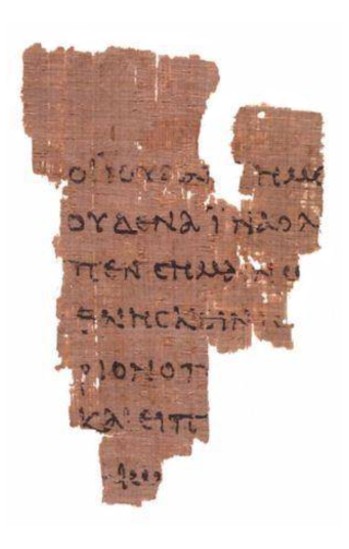
Leading the Interpretation: These graphics are of P52 which is dated to the first half of the second century.7 
Illustration 1: P52 Recto

Notice that there were no punctuation marks, spaces, paragraphing in use when the NT was written. Dictionaries and grammars as we know them did not exist in any practical way. What the student learns today is a Koine Greek that has been standardized over the 2000 years since the writing of the New Testament.

In order for the modern student to interpret 1st or 2nd century Koine writing the student must make judgments about word division, phrase division, sentence division, and paragraphing. The student must decide upon accentuation and breathing. For example: this fragment gives us two examples of diaeresis. The first can be seen in this graphic and is used according to the rules for Koine taught to students today (line 2, ουδεναϊνα). The second use is in line 2 verso (that is: on the other side) where the diaeresis follows a consonant and marks the word ϊνα. This second use is not in accord with those rules. Each of these decisions is an interpretative decision.

Modern critical editions of the GNT have made all those decisions for the reader. And if the reader is not practically aware of these decisions, these interpretations will affect exegesis unintentionally.
Illustration 2: P52 Verso

In the case of the NA text, the editors state:

The system of paragraph divisions has been developed much more extensively than before, and not simply for greater clarity. It is designed to aid the reader’s understanding of the writings by clarifying their structure, e.g., in the Gospels distinguishing the primitive units. The strophic printing of verse has been expanded, perhaps even too much at times, but further revision is always possible. The same holds for punctuation, which seeks to follow Greek usage in contrast to the earlier Nestle which was dominated by German usage, and The Greek New Testament where the influence is English. (Aland et al. 1987:44*)
For the most part one can trust the word divisions, punctuation, etc of the modern critical editions. And for the most part one can trust the text presented in them. But the exegete must never pretend that at these various layers of interpretation many significant decisions have already been made for him.

The exegete must also be aware that the textual traditions embodied in the modern critical editions of the GNT have deliberately steered away from the textual base used by Luther, the Reformers, the Confessors, and the great theologians of Lutheranism. They have done so with an explicit denial of Inerrancy and the Scriptural Doctrine of the Preservation of the Scriptures (Mt. 5:18; Jn 8:31-32; 17:20; Eph. 2:20).

Examining the text of the GNT for the sake of Lutheran doctrine is not a task to be done lightly. Since the text of Scripture is the measuring stick, the exegete must make himself aware of how far his modern critical edition differs from the measuring stick used by Lutheranism as the basis for doctrinal interpretation up to the end of the 19th century.

Notes

1C.f., the WELS doctrinal statement: “SCRIPTURAL PRINCIPLES OF MAN AND WOMAN ROLES” Principle #20 “Christians also accept the biblical role relationship principle for their life and work in the world (I Co 11:3; Eph 5:6-17). Christians seek to do God's will consistently in every area of their lives. We will therefore strive to apply this role relationship principle to our life and work in the world.” And also antithesis #6 “We reject the opinion that male headship and female submission apply only to marriage or only to marriage and the Church (1 Co; 1 Ti 2:12).”
http://www.wels.net/cgi-bin/site.pl?2617&collectionID=4446&shortcutID=5294
2WELS Q&A on whether a WELS woman could be a doctor in charge of a practice with men under her authority,
http://www.wels.net/cgi-bin/site.pl?1518&cuTopic_topicID=30&cuItem_itemID=6854
3WELS Q&A on WELS member Michelle Bachman's run for political office,
http://www.wels.net/cgi-bin/site.pl?1518&cuTopic_topicID=30&cuItem_itemID=13874
4For example: influential academic journals- Vetus Testamentum, Novum Testamentum, Zeitscrhrift für die alttestamentliche Wissenschaft and Zeitscrhrift für die neutamentliche Wissenschaft; influential academic commentaries International Critical Commentary, and the “Polychrome Bible” of Haupt.
5Abrahamson 2005.
6Other examples: Metger 1975:xxiii, Aland, et al., 1987:41*, Aland & Aland 1987:4, 6-7. Remember that these are the lead editors of the UBS GNT and the NA.
7JRULM 2005.