Showing posts with label Hebrew Bible. Show all posts

Monday, November 19, 2018

Kings of Assyria and the Book of Isaiah--Lecture Part 3

Lecture for Lutheran Theological Seminary-Nyamira, Kenya. Part 3.


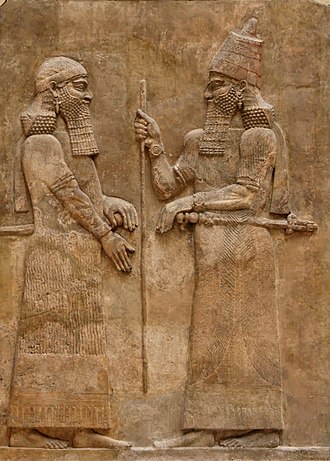
Sargon II (r. 722–705 BC)

Assyrian: Šarru-ukīn (LUGAL-GI.NA 𒈗𒄀𒈾);
Hebrew: סַֽרְג֖וֹן
Greek: Αρνα, Σαραγω, Σαργων, or Ἀρκεάνου
Ekegusii: Sarigoni

Isaiah 20 begins with the note:
“In the year that Tartan came to Ashdod, when Sargon the king of Assyria sent him, and he fought against Ashdod and took it”
This is the only mention of Sargon in the Bible.

The capture of Ashdod probably took place in 711 BC, in Sargon II’s 10th or 11th year.

Sargon II was the son of Tiglath-Pileser III. From what we can find it looks like he usurped the throne from his brother Shalmaneser V. His son, the crown prince, Sennacherib, pictured in the carving, assisted in ruling.

Monday, November 12, 2018

Kings of Assyria and the Book of Isaiah--Lecture Part 2

Kings of Assyria in the Historical Context of Isaiah

Lecture for Lutheran Theological Seminary-Nyamira, Kenya. Part 2.

Assyrian kings contemporary with the kings of Judah and Israel listed above include the following. The first list is of those Assyrian kings who are included on the 8th century BC king lists. Listed here also is the approximate years these kings reigned.

Ashur-Dan III (r. 773–755 BC)

"son of Shalmaneser (IV)"
     solar eclipse 763 BC— Bur-Sagale eclipse
contemporaries:
     Uzziah of Judah (r. 767–750 BC)
     Jeroboam II of Israel (r. 786–746 BC)
Book of Amos
Book of Hosea
Book of Jonah

Monday, November 05, 2018

Kings of Assyria and the Book of Isaiah--Lecture Part 1

Kings of Assyria and the Book of Isaiah

Lecture for Lutheran Theological Seminary-Nyamira, Kenya. Part 1.


The Assyrian Kings play a prominent role in the Bible.

This presentation is intended to give concrete examples of how modern historical research touches upon the text of the Bible, particularly the book of Isaiah. It is written to give students a clearer understanding for the benefits of and for the limits of both Biblical interpretation and historical research used in the interpretation of the ancient world and of the book of Isaiah in particular.

Scope of Assyrian History


The history of the Assyrian empires is commonly divided into four periods by modern historians.
  • Early Assyrian period (2450-1906 BC)
  • Old Assyrian period (1905-1931 BC)
  • Middle Assyrian period (1380-912 BC)
  • Neo-Assyrian period (912-608 BC)
Of these periods the Neo-Assyrian period is relevant to the immediate historical context of the book of Isaiah. In the 12th century to the 10th century BC the ancient world seems to have experienced a wide spread change. Historians today call this the Bronze Age Collapse. While Assyria was able to retain its national character, it was reduced in size and influence throughout the ancient Near-East.